Animals Are Not Machines, Ross Douthat
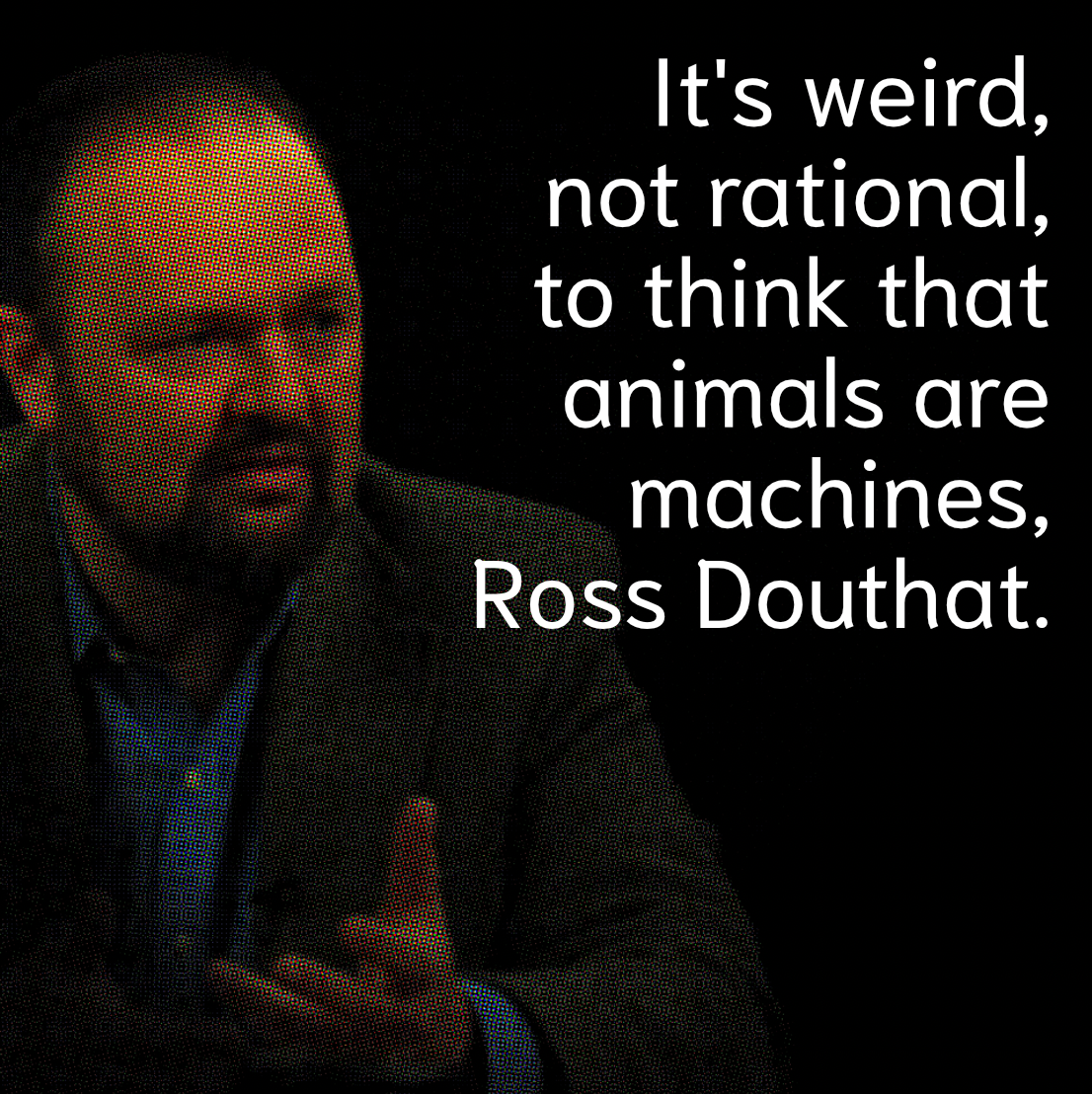
Full Transcript:
Welcome back to Not Everyone Believes, Ross Douthat. This is a podcast that reviews in detail, a book by Ross Douthat.
Ross Douthat is a right wing Christian commentator. He is a member of the right wing team that has taken over CBS. CBS 60 Minutes is where Douthat has planted his roots now. He's a commentator there under Barry Weiss, who was brought in in order to make Donald Trump happy with CBS.
This isn't about 60 minutes, and this isn't about CBS, though. This podcast is about a book that Ross Douthat wrote called Believe: Why Everyone Should Be Religious.
We've gone from the cover through the acknowledgments and into the introduction so far, and now we're moving into chapter one, because the rest of the introduction to this book is what you would typically find in an introduction.
The introduction continues by saying what the book is going to say without really going into any detail without providing any evidence for any of the assertions that are made. It's just a sort of scope of what the book is going to be. So, we're going ahead to page 16, in the first chapter.
The first chapter is given the title The Fashioned Universe, and that should tell you what this chapter is really all about. It's all about promoting a Christian Creationist model of the world and saying that you ought to believe in it based on the facts, the facts of reality.
Now, you know, Ross Douthat says that his book is just promoting religion in general with the idea that there is a Creator. He's asking you to overlook the fact that there are religious traditions in which there is no clear Creator God. Ross Douthat seems either unaware of that, or not particularly to care.
Ross Douthat vision is continually that of a Christian perspective. That's what this book ultimately is about. It's not promoting religion broadly, but Christianity and Rostowitz's version of Christianity.
This chapter is all about asking you to accept that the world is created by a powerful spirit that he calls “God”. “God”, by the way, is a Christian word. It is not a universal word for religions around the world. So, every time he talks about God, he's talking about Christianity.
Anyway, we're going to page 16 and 17 to address a couple of specific passages, and the idea that is at the root of Ross Douthat’s argument, which he says is logical, is rational, is reasonable.
What Ross Douthat is doing in this first chapter is asking you to go back to imagine that you're not living in this world that we actually live in, where there's science and reason and facts and empirical research. He's saying, go back further, and imagine before that, before you knew about any of that. You could go back individually, to your childhood, or go back to kind of recreate in your imagination a scenario that he admits isn't historically accurate, but to try to recreate an imagination of what it must have been like before the Enlightenment, before we had Galileo and Copernicus challenging Christian Orthodoxy.
What Ross Douthat says is that you're going to automatically, in that world of your early childhood or of pre-Enlightenment, imagine that the world is the creation of an invisible, all powerful spiritual being.
Why would you do that?
Ross Douthat writes, “In your own embodied existence, you find yourself surrounded by complex machines of flesh and bone, filament and fiber, animals and insects, trees and flowers, their individual operations woven together in still more complicated ecosystems, and these systems don't just manifest a crude functionality, they often seem beautiful, graceful and sublime, offering visions that even on an ordinary day can stir extraordinary awe, that both inspire and exceed the human capacity for art.”
Sure, nature is beautiful sometimes, but sometimes it's terribly ugly. Ross Douthat seems to want to ignore that.
Then we go to the bottom of page 16: “In this initial reaction, your naive self finds religion, rational, and necessary because you yourself sense your subordination within a higher order. You recognize yourself as a creature in a created landscape, a small participant in some grand design, a mind, in some dependent relationship with higher minds or with the highest Mind of all.”
Then to the bottom of page 17: “Pondering the seeming orderliness of the cosmos, its complex detail and design points to the existence of some divine intelligence.”
Can you see what Ross Douthat is getting to here?
The essence of the argument in this first chapter is that Douthat thinks that if you just strip away all of the secular culture and scientific knowledge, well, everybody just looks at the world naturally as if the entire world is a machine, and all of the animals and plants and fungus are machines, and the rivers are machines, and rocks are carved made by somebody, by an intelligent mind, a Creator who is naturally above you in a divine hierarchy.
Do we naturally look at the world in that way, though? I have to say, I don't. I find it to be completely weird.
I have never looked at a cow, for example, and thought, “Wow, what an interesting machine that is.” I've never looked at a waterfall and thought, “Wow, who made that waterfall?” I've never looked at trees and said, “Oooh, who carved that tree? Who made the tree?”
This is something that Ross Douthat has done because it’s in accord with what Ross Douthat was raised to believe, the way that he was raised to look at the world. Ross Douthat was raised as a Christian. He didn't choose that religion for himself. It's what he was trained to believe, and in Christianity, you're trained to interpret everything you see around you as the creation of some super powerful spirit.
There is nothing in the natural world that shows us the existence of that spirit. He believes that just everybody sees it all around them, that obviously, everything is a Creation, and therefore there has to be a Creator, Everything is sculpted, so therefore there has to be a sculptor, everything is designed intelligently, and so therefore there has to be a designer.
If you are not raised in that tradition, you just don't see that. you don't necessarily know where things come from.
If you're a young child, and you're wandering around, and you see horses running in a field, you might wonder about the grass. You might ask, “What is that stuff, and what is a horse?” You don't think, “Oh yeah, God, totally, this big cosmic spirit totally made these things.”
It's just not something that you see. You certainly don't say, “That horse is a machine.”
Here's why: One of the things that you learn really early on is that things die.
It's really interesting because Ross Douthat so far is really not talking about death in this book very much. I find that interesting. There's a kind of invisibility, ideologically, to death, and pain, and the suffering, and the ugliness, and difficulty of the world.
Douthat just seems to kind of glide over that.
Maybe it's his own fortunate upbringing that leads him to do that. I don't know, but death isn't just the end of things. It's not just the destruction of a thing. It is the end of life specifically, and it's death that tells us what life is and how it works and how an animal, a plant, even a fungus is different than a machine.
With a machine, you can take it apart. It is not complex. You can take it apart and then reassemble it and the machine still works.
Try doing that with a grasshopper. Try doing that with a cat. Try doing that with a person.
We all learn this from a very early age: Once you kill something, it's gone. That's because life is a complex system that cannot be reduced to its parts. It is not like a machine. If you take a living thing apart, It does not regrow. If you kill it, you cannot just put it back together and make it work again.
In that way, in that basic experience of life, we learn that death is real. Death is the end of a complex system. It's not just that a machine has been taken apart. It's not just that you can take that living thing and then transport it somewhere else and then magically it reappears.
That doesn't happen. We never, ever, ever see that happen.
The only way that you could experience animals and plants in the world, as if they are machines, is if you deny the reality of death.
I think an emotionally healthy upbringing doesn't bring you that denial of death. Death is hard. Death is. It's a really scary kind of tragic thing, but if we are looking rationally at reality, we see that animals don't seem to be Creations. They don't seem to be machines. There's no intelligent designer with them.
They are systems that appear and they reproduce themselves and they live within these complex systems that, hey, maybe we don't understand at an early age. Even if we are biologists, you know, there are lots of great things to investigate with life. Do we have all the answers about it? No.
Nobody has all the answers about anything, but we know that for certain these things are not machines.
If you don't accept that dogs and birds are like machines, then Ross Douthat’s entire argument in this first chapter falls apart. If you recognize that life is complex and not created, that it's not a top-down decision, that instead it is mysterious in the sense that the world is an amazing place and it takes a long time for us to understand things, you approach the world that we live in with questions, not with easy answers.
That's the thing that Ross Douthat seems to be overlooking. Ross Douthat is presuming that if you have a child who comes up with easy answers to the complexity of the world and of life, that those answers must be true, that somehow there's this noble savage wisdom with which if you happen to look at the world and you decide that, wow, things must have been created, then that must be true.
In fact, that isn't necessarily the only reaction to the world. In fact, you have to kind of ignore a lot of reality to come to that conclusion. You have to ignore what makes life different. You have to ignore the mysteries. The other thing you have to ignore is that you never actually see the world being made being created.
If you're a child, and you come into this world, or if we go back before the Enlightenment, and you try to really pay attention to what people are seeing and what they're not seeing, one thing is obvious: Nobody ever has recorded seeing God making the world, or has seen that there's an actual spiritual being, so that you can watch them make an animal or a plant or a rock, or a waterfall, much less the entire planet and the stars and things like that.
If you really think that it is self evident that the world is created, then you ought to see the Creator, but nobody ever sees this Creator making anything.
If you go into an actual factory, and you conclude that this factory is making lawnmowers, those machines with internal combustion engines that make a lot of noise, and you go into a lawnmower factory, you don't just see that there's an assembly line. You don't just see that there are parts, and then you don't just see the finished products. You go in there, at least Monday through Friday, and you're going to see people putting those machines together, and making them work out of the parts. You see the different steps of the process.
There is nothing that we see in the natural world that is like that at all.
You don't see butterfly parts in the world, and then see some spirits or gods or anything magical like that, putting those butterfly parts together and making the butterfly.
So, Ross Douthat, argument here is in fact, counter to the facts, counter to what we observe. It is presumptuous. It involves several different leaps of faith, and it ignores the human experience that we have of this world.
In short, it's a complete failure, the very foundation of chapter one.
Of course, Douthat talks about other things too in chapter one. He's talking about “mystical and numinous experiences.” Numinous, you’ve got to love that word. It means kind of woo woo, is what it means. It means magical things, woo!
We are going to get on to that in the next episode.
For right now, all we can say is, Ross Douthat, not everyone believes that there's a Creator, because no one's ever seen the world actually being created.
Not today, not yesterday, not last year, not ever have we seen a person or a spirit, a god with the tools putting the world together. That lack of evidence is simply immense, and it's really difficult to ignore if you're not brought up with the presumption that it must be true.
That's why not everyone believes Ross Douthat.