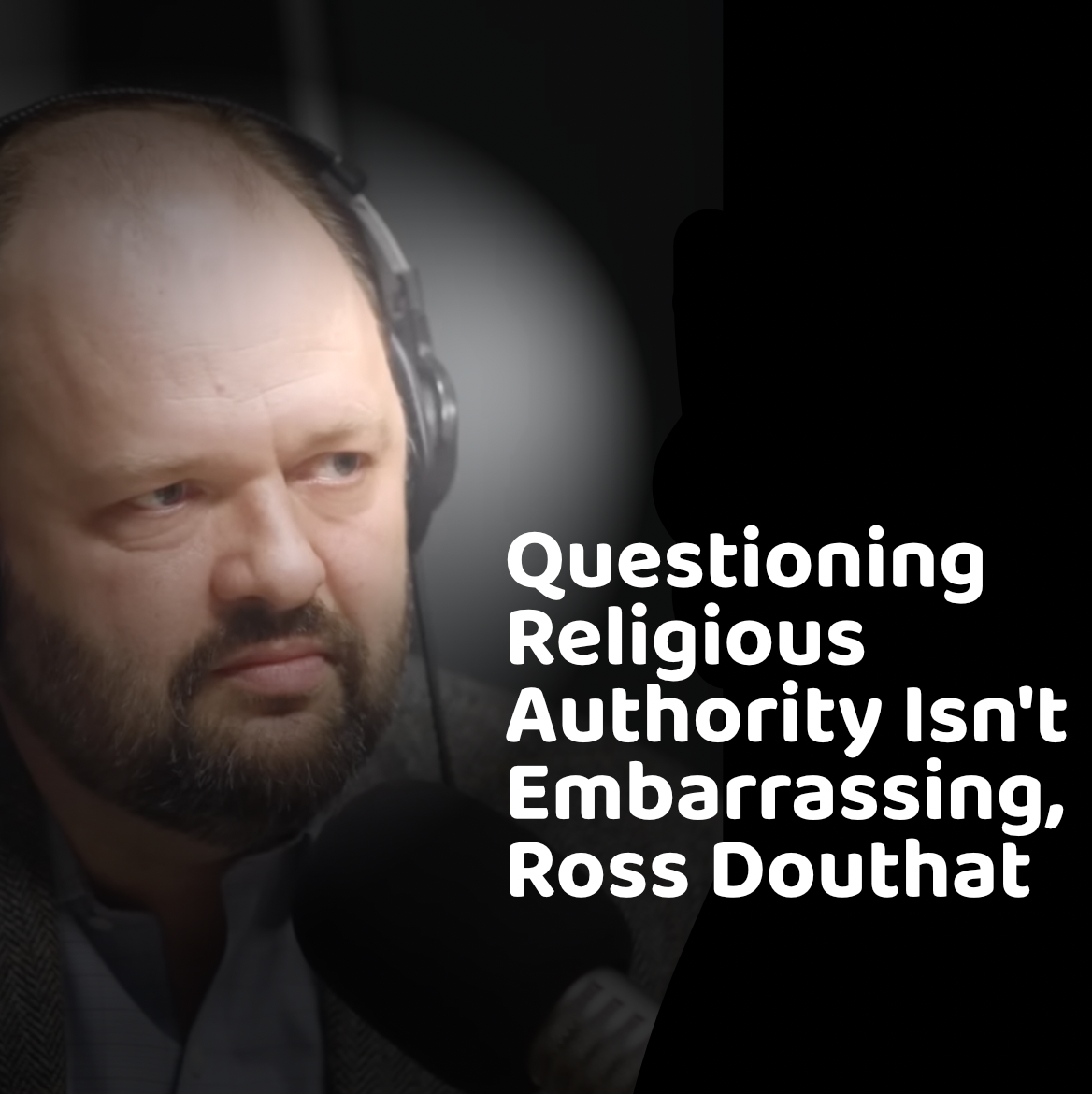
Ross Douthat argues that scientists and atheists are to blame when religious people discover that what Christian preachers tell them isn’t true. Douthat is angry at skeptics embarrass people by pointing out the crazy lies of religion. Why isn’t he angry at the religious lies?
Podcast Transcript:
Welcome back to Not Everyone Believes, Ross Douthat. This podcast is a page by page, line by line examination of the claims that are made in Ross Douthat's book, Believe: Why Everyone Should Be Religious.
That's the title of the book. The author is Ross Douthat, who is, well, you just have to call him a media elite. He's at the top of the media.
Ross Douthat is making a killing, and he's got a lot of allies in Donald Trump's, Make America Great populist, fascist, Christian Nationalist movement. That's why he was given a position at 60 Minutes, which is now a right wing media outlet.
The core argument of Ross Douthat’s book is that belief in religion is rational. What’s more, Ross Douthat argues that refusing to believe in religion, or deciding that you just don't believe religious doctrines and dogma, that's the thing that's not rational.
We're in chapter 3. We're on page 73 now.
On page 73, Ross Douthat is pulling a kind of emotional maneuver. He's summoning the reader's resentment against people he suggests are elites. This is kind of ironic because Ross Douthat himself, was born to a family of privilege. His grandfather was the Governor of Connecticut. He went to Harvard. He then went on, through his social connections to work at the New York Times, where Michael Barbaro, who is another member of the New York Times media elite, happened to be the best man at his wedding.
Ross Douthat has got all kinds of chummy high society connections, but he's talking about how scientists are an insufferable elite. Let me give you some of Ross Douthat own language with this.
Ross Douthat says that people, when they have religious or supernatural experiences, they are…
“…embarrassed to talk about their experiences at all, since they assumed that doctors and psychologists would sneer at them. That embarrassment is itself a key feature of our times. Yes, there is some natural human eagerness to believe in the supernatural, some persistent fascination with the marvelous or eerie, but as Official Knowledge has marginalized the mystical, that eagerness coexists with the opposite sort of pressure to dismiss supernatural experiences, even one's own supernatural experiences, lest one appear deluded or disreputable.”
Ross Douthat goes on to talk about how Official Knowledge just doesn't allow any space for the supernatural, or religion. Poor, poor religion just doesn't have any space, he suggests. No one has any space to talk about supernatural things and then doctors and psychologists, those science people, they just sneer at you or people.
Notice what Ross Douthat actually says. He says that people are afraid that doctors and psychologists will sneer at them. Why are people afraid of that?
Let's look at this rationally, which means let's look at the facts of what's going on. Is official knowledge actually shoving supernatural beliefs out? Is it so that there's no space within institutions of higher learning, for example, for ideas that are religious or in other ways supernatural and magic
No. That's simply not the case.
There are 482 accredited colleges and universities in the USA that have a religious studies department. If you know anything about departments of religious studies, you know that they are overwhelmingly staffed by professors who themselves believe in religion. It’s not absolutely all of them, but most of them.
Most of them come out of religious backgrounds. That's why they got a degree in religious studies, because the professional pathway is to get a degree in religious studies and then go become a religious preacher. So, there are 482 accredited colleges and universities that are training people to go out and become religious, and certainly encouraging students to go encounter religious ideas and to take them seriously.
There are 850 accredited American colleges and universities that are religiously affiliated, many of them controlled by religious organizations. There are many more unaccredited Bible colleges devoted to teaching Christianity.
So actually, Official Knowledge is thoroughly infused with religion. Official Knowledge provides dedicated special places, protected spaces, where religion is given a voice, where the supernatural can come in as a topic so that people can talk about it and take it seriously.
Let's also look out on Main Street Official Knowledge. Where are the institutions in our communities?
There are over 350,000 Christian churches in the United States of America. They are staffed by people who are preachers and priests and bishops and things like that. These are people who claim to have Official Knowledge.
Are those churches being shut down? No, not by outsiders. Sometimes the churches are shutting themselves down because they just can't bring in enough people anymore, but that's a separate issue. There is no one from the outside shutting those churches down.
We can take a look in the government. That's another source of Official Knowledge. You know what happens around the country now? Government meetings are led by Christian prayers. That's how they're opened up. They get a local preacher in there and they give a Christian prayer as a ritual opening to government meetings.
What about in government schools? K through 12, high schools, elementary schools, middle schools, in an increasing number of states, are actually teaching Christian religion. It is legally required for a public school, a government-run, institution, to have the Christian-defined Ten Commandments. (Actually, in the Pentateuch, there are lots of commandments, but there are not 10 that are designated in particular. Christians have decided that there are 10 and decided what they look like.) Government schools are required legally to post that on the wall. So, public schools are being used to spread religious knowledge.
What's the equivalent for skepticism and for atheism?
Let's not look at science and say that, “Well, there are also departments of biology and chemistry and physics in universities.” It's true that those science departments exist, but science is not anti-religion.
Science is neutral in terms of what's real and what's not real. Science is neutral, because it has a process of separating sense from nonsense, reality from non-reality. Science uses really rigorous techniques to do that. Science is not just sneering at people and intimidating them and making them feel like they're outsiders.
Of course, there are scientists who are jerks, because there are people who are not nice in every group of humanity, but the scientific process itself is not at all anti-religion actually. I think you'll find that most scientists are perfectly decent, nice people. They don't engage in a programmatic suppression of religion.
Science is not anti-religion. It's neutral toward religion. It critically examines everything.
Science does critically examine claims that are made by religious believers. Yes, it happens that if some faith healer comes along, and claims to have certain abilities to heal people, through touch or through magic elixirs, or holy water, or stuff like that, scientists can come along and critically examine those claims. Critical examination means to take rational processes and look at the facts related to what religious people are saying.
Do you know what happens much more often than that, so much more often? Most of the time, scientists are critically examining what other scientists say.
Should Ross Douthat say, “Oh, people are afraid to go into science because they're afraid that scientists are going to sneer at them, and they're going to ask difficult questions about their work. Oh, that's so terrible. That's a pressure for people not to be scientists.” Would it be reasonable for Ross Douthat to say that? No, it would not be reasonable.
Critical examination does not create a pressure for people not to be scientists. Critical examination creates a pressure for people to do good work when they are scientists.
It's a pressure, yes. There is a societal pressure to not babble nonsense when you're working at a university or college. Yet there is that safe space of all of those religious studies departments, hundreds upon hundreds of them, all across the country, in colleges and universities that are in their very foundation constitutionally accommodating to religion. In fact, many of them are promoting religion.
Official Knowledge is religious all over the place. What about the federal government?
We now have, in the White House, an official White House Office for religious affairs, the White House Faith Office. In most branches of the federal government, you have Christian prayer meetings being held by the leadership, pressuring everyone in the government to take part, ostracizing people who do not take part.
There is actually pressure and forces of social embarrassment against non-believers in religion from the federal government.
The U.S. military has become an organization that practices religious indoctrination. Pete Hegseth, the Secretary of War, as he fancies himself, the civilian leader of the U.S. military has declared that the war against Iran is being done in the name of Jesus, in the name of Christianity. He has established an official Office of Religious Affairs within the Pentagon in order to assess and maintain soldiers’ spiritual readiness, their spiritual aptitude, their spiritual health.
The US military is huge, and the U.S. Military is now being used to pressure soldiers to worship, and not just to worship generically, but to follow Christianity specifically, and not even just to follow Christianity in general, but to follow certain kinds of Christianity.
The Pentagon has eliminated official recognition for more progressive forms of Christianity, such as Unitarian Universalism. You can't be recognized as a Unitarian Universalist, or a Unitarian or a universalist separately, by the military. The military now requires soldiers to describe themselves as a member of some other Christian denomination if they belong to Unitarian Universalist associations.
Under Pete Hegseth, the Pentagon also has no official recognition of atheists or humanists. Soldiers are simply not allowed to describe themselves in those terms. They have to recategorize themselves as agnostic, which means that they're no longer really certain that there is no God, with no gods at all. Now they have to describe themselves as not being sure, like they just haven't made up their minds.
All the while, the U.S. military and the U.S. government is infiltrated by huge numbers of, almost always Christian, chaplains. There are Christian chaplains teaching soldiers to be Christian in the US military.
Also in the U.S. Congress, every day, the U.S. House of Representatives, and the U.S. Senate, is opened not by some kind of appointed government official who has experience and expertise in secular affairs. No, both houses of Congress are opened by a Christian chaplain. There has never been a non-Christian chaplain in those positions. The U.S. Congress can't open if there isn't a prayer and a little sermon given by a Christian preacher first.
So if we want to talk about Official Knowledge in the United States of America, the facts show that Official Knowledge is thoroughly dominated by a religious perspective, a supernatural perspective in general, and by a Christian perspective specifically.
So why is Ross Douthat claiming that the opposite is the case? Ross Douthat is performing a really sad kind of maneuver that is being performed to reposition non-religious people and non-religious perspectives as somehow being an elite within the United States that's unfairly persecuting Christianity.
Christianity has, a matter of faith, a belief that it is a persecuted religion, even though Christianity has been spread at the point of the sword, thanks to the Roman Empire, and then through colonization by Christian powers and Christian kings. The truth is that Christianity has long been a socially elite religion that is spread and maintained through government power. Thanks to Christian nationalism, that's what we're seeing again in the United States of America. After we've tried to be a secular nation, we're now going back to the colonial standards of the British Empire, having Christian religion privileged in the United States of America.
If you are a parent and you go to your school, and you ask please that your child not be forced to say the Pledge of Allegiance, pledging allegiance to one nation under God, or if you go to a public local government meeting where they open meetings with a Christian prayer and you ask simply to have the space be open and neutral, available for people of all different positions and not Christian ones, what happens to you? You get sneered at. That's where the real sneering and social pressure and the use of embarrassment is going on in the United States. It’s being done by Christians against non-Christians.
People like Ross Douthat try to turn that around and say that poor Christians are just beset by embarrassment. Ross Douthat claims that when people point out that Christians believe things that aren't true, it’s terribly embarrassing. Ross Douthat suggests that it's an unfair persecution when people point out that Christianity doesn’t match reality.
What Christian apologists like Ross Douthat are trying to do, when they pull this line of argument, is to lean into that feeling of embarrassment. The are trying to get people to resent it when people carefully and rationally examine reality, to blame them for the feeling of embarrassment that sometimes people have when they realize that they have believed something that isn't backed up by the facts.
Realizing that you’ve been wrong can be a truly embarrassing thing, but it doesn't mean that someone else is embarrassing you. It usually means that you yourself have realized you've been wrong, and you feel this regret, and you start to think, “How have I been wrong about this for so long?”
What Ross Douthat is trying to do is create a kind of escape hatch, so that a person feeling that way can redirect their feelings of shame that they put on themselves, and then go blame other people. By blaming others, the hope is to bring doubting Christians back into the religious fold, to bring them back into the Christian fold.
It’s a tactic for persuading people to remain within Christianity by creating an emotional narrative of external persecution of religion, and of Christianity, when in fact, it's Christianity that is persecuting other people. It's Christianity that is putting ICE agents out in the streets through the Department of Homeland Security, to gather people up and shoot people on the streets of the United States of America. Tom Homan, who runs that project, is regularly posting Christian memes online. The leader of the Department of Homeland Security, Markwayne Mullin, is regularly having Christian prayer meetings and is posting messages about how the United States is a Christian nation led by God, in the name of Jesus.
Ross Douthat may quibble with Donald Trump now and then, but he is providing support for the fascist Christian nationalist takeover of the United States of America by giving Christian Nationalists a rhetorical escape hatch. Ross Douthat has created a defensive argument that tells people when they discover that what they believe is not in accord with reality, that it’s not factual, ’that it’s not rational, they don't have to leave Christianity. Instead, doubting Christians can take that difficult emotion that they feel, and project it back outwards against science, against thinkers, against education, against atheists and skeptics.
Ross Douthat is telling doubting Christians who feel embarrassed about the irrational and antisocial aspects of their religion that they can blame atheists, that non-believers are the problem. They're the ones who are trying to keep you down. They're the ones who are asking you to think, and now they've made you feel embarrassed. Isn't that awful of them?
The initial embarrassment of realizing that you're wrong is a chance to show maturity. The mature option is to adjust what you think, and what you do, according to what you discover about reality.
The immature reaction is being preached by Ross Douthat: To blame other people, to cast yourself as a victim of other people, when really you just discovered that you yourself were wrong.
When Ross Douthat makes his claims about nasty scientific Official Knowledge embarrassing religious people so that they're no longer feeling secure in their beliefs, he’s engaging in a kind of political manipulation to keep Christianity in power.
It isn’t working. In spite of the fact that so many people are pushing this argument, increasing numbers of Americans have had it with religion. They are walking away, and they are beginning to question their beliefs. Good for them.
For too long, they've been listening to people like Ross Douthat, who are telling them that they can only be accepted if they have the right beliefs, that they can only be accepted if they go to the right church that they can only be accepted if they agree to certain religious principles and to the power of religious individuals and organizations to control their lives.
There has been too much manipulation, too much control, and too much use of shame by Christian preachers telling everybody else who doesn't agree with them, that they ought to be ashamed of themselves, that they ought to be embarrassed, that they ought to get back in line and obey, or else they'll be punished by God and sent to Hell.
That's where the real embarrassment comes from. That's what real Official Knowledge looks like
Don't blame the scientists. Don't blame a biologist for the fact that evolution through natural selection works. If you were taught by your parents that evolution is real, and you grew up and then you found the facts, and you realized evolution is real, don't blame scientists for embarrassing you. Blame your parents for not telling you the truth. Blame your preacher, for telling you that you would go to Hell if you accepted the truth.
In spite of the massive attempts at social control engaged in by the religious organizations that Ross Douthat defends, not everyone believes.