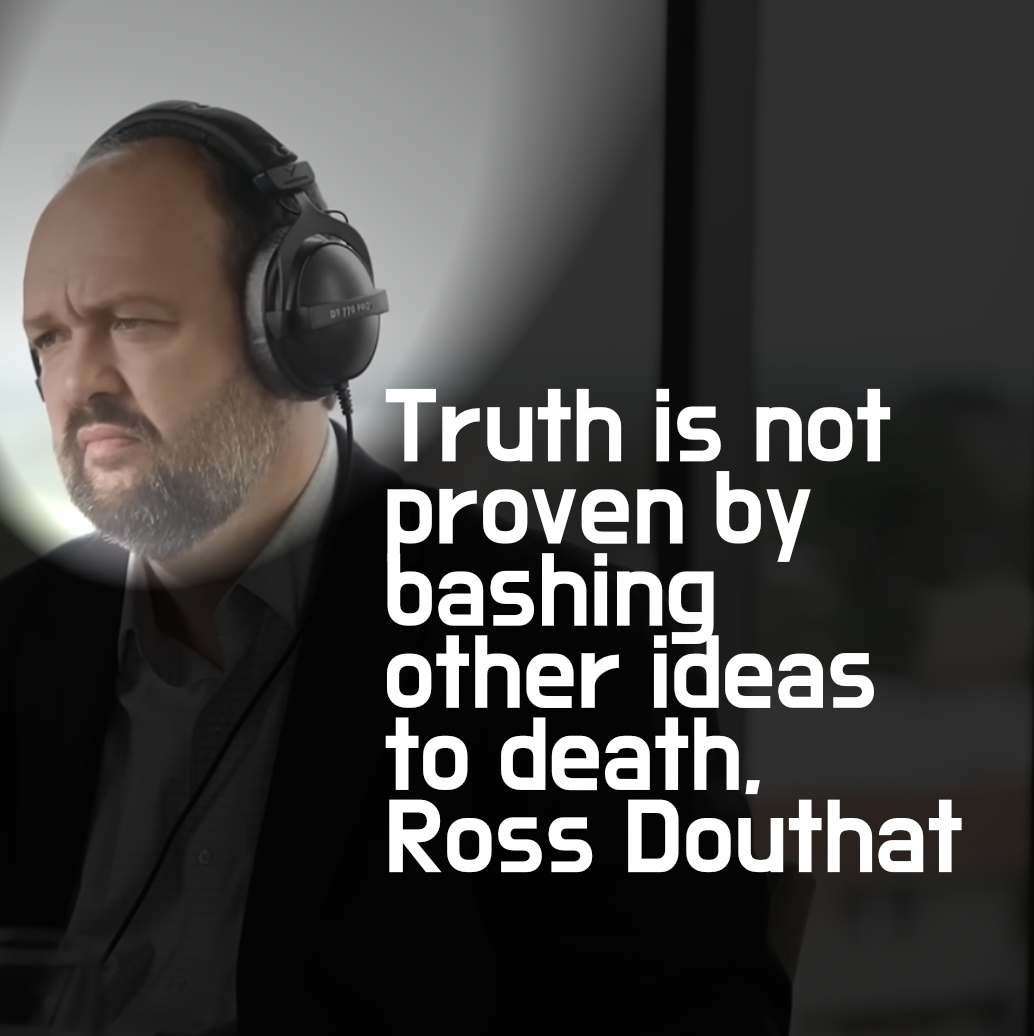
Welcome back to Not Everyone Believes, Ross Douthat. This is a podcast that is reading through a book called Believe: Why Everyone Should Be Religious. It's a book written by right wing political extremist, Christian pundit, Ross Douthat.
We're getting to the part of the book now where Ross Douthat is repeating himself. It kind of looks like, the way that this book reads, Douthat really struggled to find enough things to say to fill up a book.
In this new chapter, chapter five, called Big Faiths and Big Divisions, but so far Ross Douthat is just repeating what he’s already said in this chapter. I’ve reading through seven pages of this chapter to get to this point where we're going to be today. It's the same old idea that he's written about before: You should go along like a lemming with everybody else. You should believe in religion because that's what most people are doing. You should believe in a religion, specifically that the most people believe in, because large numbers of people are always right.
Oh, the wisdom of crowds. You know what happened with the wisdom of crowds this last week? There were these prediction markets where you can gamble on public events, such as the election of the leader of Brazil, and the prediction markets were all saying that Bolsonaro, the right wing Christian nationalist would win the election, become the new leader of Brazil, and Silva, the more progressive, not quite so Christian nationalist, candidate would lose. Those prediction markets were profoundly wrong.
Stock market crashes are another example of this idea, where often crowds are wrong. Remember NFTs? Those were blockchain enabled graphics or other forms of media that had hidden within them these kind of crypto ledgers and nobody could ever really figure out what they were about, but there was a bunch of hype and so people just rushed in to buy them. Matt Damon was out there promoting them, saying, boy, you are going to miss the boat if you don't go along with this trend. Then, they all ended up being worth practically nothing, selling for fractions of a penny each, when they had been selling for thousands and even tens of thousands of dollars on the market before.
It was all a deception. There were people who owned a lot of these things and they were doing self trading to make it look like there was a demand for these things when there really wasn’t. A lot of people went along with it, and a lot of people were wrong.
George W. Bush’s rush to invade and occupy Iraq is another example of the stupidity of crowds. The majority of Americans believed Bush’s lies. They believed that Saddam Hussein had terrible weapons of mass destruction that made it necessary to for the USA to go to war. They were wrong. There were no Iraqi weapons of mass destruction. The crowds were not wise. The crowds were bloody idiots.
Ross Douthat seems to be overlooking the fact sometimes the majority of people are just plain wrong.
So, on page 131 of Ross Douthat’s book, he has been, for several pages, making this same argument all over again. It makes me feel like he's just trying to puff up the page count in this book so that it doesn't come off as what it really is, which is just a pamphlet without very many thoughts behind it.
On page 131, Ross Douthat has come up with a particular argument that I want to examine because it relates to Christian doctrine in particular.
The first paragraph reads:
“It’s a reasonable bet that the big, resilient, long enduring faith traditions, Christianity, and Islam, Hinduism, and Buddhism, are more likely to stand in a strong relationship, to the truth about existence, than religions that flared and died, that subsist in cultural isolation, or that came into existence the day before yesterday.”
Ross Douthat seems to think that he's being clever, trying to have a kind of survival-of-the-fittest argument, but not with biological species. It's with religions instead.
Actually, the more up to date versions of the models of biological evolution through natural selection can indicate to you is that some species, or even some ideas can, survive for a long while, and then they can go extinct, because conditions change. Conditions are not permanent.
There's not one eternal truth, one strength, that everything is trying to be closer to. Biological evolution is not the story of a bunch of life forms trying to become human, with humans obviously being the best and everything else out there being a failed version of humanity, in which a jellyfish doesn't do very well at being human, but monkeys do better.
You can have species that have very small numbers, but they're very well adapted to small, niche environments. On the other hand, you can have adaptations come along that would have been great in another situation, but because they came up in a situation that was badly suited for those adaptations the animals that carry those adaptations don't survive. The species goes extinct.
It’s not that the animal was bad. It's not that the animal is wrong. It just had a mutation in the wrong circumstances.
That’s where Ross Douthat just can't match the sophistication of the idea of biological evolution through natural selection. Ross Douthat is caught up in the childish idea that there is Truth and that everything is in the universe is just either true or false is either in accord with that Truth and with God, or it's not.
Douthat argues in this chapter that maybe you can have different distinctions of Truth according to that one absolute standard of God, but God is what Truth is, and everything is either more true or less true than the Truth that God defines, more or less true than Christianity.
That's not how adaptation through natural selection works, though, so this idea Ross Douthat has come up with of religions competing against each other in a competitive marketplace, with the survivors being closer to the truth, it really doesn't hold water.
For example, there could be a religion like, oh, I don't know, let's say Christianity. This religion has small numbers for a long time and is really struggling to gain adherents Then it's picked up opportunistically as a tool by the Roman Empire. The emperor decides to use this religion to gain power and to control people. Thus, Christianity gets the military power of the Roman Empire. The violence of the empire spreads that religion, not because it has truth merit, but because the Romans are slaughtering anybody who doesn't agree with that religion.
When soldiers go and kill all of the members of another religion, does that show that a religion is more true? According to Ross Douthat's argument, it does.
This idea of the wisdom of crowds doesn't even hold water within Christianity. In Christianity, starting in Judaism, but then going forward into Christianity, you have all of these stories about how people actually tend to make the wrong decision.
You can find this religious idea of the stupidity of large numbers of people in the idea that people are naturally sinners and naturally mistaken. They just keep on making the wrong decisions.
The Christian belief is that human intuition just can’t be trusted. There's thestory of what happened in the book of Genesis when God was a genocidal killer and he killed off all of the people because he made them, but then they all ended up doing the wrong thing. All of humanity was thoroughly wrong about pretty much everything, according to the Bible.
If we were to follow the logic of Ross Douthat, we would say that whatever all those people were doing, because most of them were doing, it must have been right. Whatever the most people do is closer to the truth.
This genocidal story from the book of Genesis, the story of God sending this flood to kill almost all people on Earth, clearly shows that this idea of Ross Douthat’s doesn’t work, even within Christian faith.
It's not just the book of Genesis, of course. We can also go to the story of Moses. Moses got those 10 commandments, right? God gave Moses a whole bunch of tablets with a bunch of laws that everyone was supposed to follow.
You know what happened next. The Jews who were wandering through the desert, trying to get back to their promised land, started worshiping other gods, the Golden Calf and that sort of thing.
This comes up all the time, over and over again in the Old Testament. Moses had to get angry and kill a bunch of his followers for believing the wrong thing, just to get the others back in line.
Once again we have the idea of killing people for not believing the same thing that you do. That's a trend in Christianity, isn't it?
That trend, of course, continues in the New Testament, in the Book of Revelation. I hate to break it to all of you Christians out there that think you're going to be raptured up, but the New Testament seems to say that only 144,000 Christians are the true believers. It's a relatively small number, and they're the only ones who are going to get saved from being tortured by God, killed by God, then raised from the dead to be tortured again by God.
So once again, you have this idea in Christianity, the Christian text itself in the New Testament, that the true faith is harbored by a small number of people, not by a large number of them.
Ross Douthat is trying to do something that makes him feel like he's being a little bit more liberal, which is to say, okay, okay, yes, there is one really True religion, and that's my religion. That's Roman Catholicism. Yes, that is the True, truest of True religions, but maybe there can be other ones that have little elements of truth, and maybe they're damning themselves to hell, and eternal destruction and torture and punishment for having something's wrong, but hey, the other religions are not completely wrong, so that's better than being an atheist, at least.
Once again, Ross Douthat is ignoring what Christian doctrine and the Bible actually says. When we go back to those commandments of Moses, one of the favorites that is included by Christians in what they like to call the Ten Commandments. Is this one: “Thou shall have no other god but me.” You shall not follow any other god but me. There's only one, and everything else is wrong, wrong, wrong, wrong, wrong, wrong.
So what's the lesson of chapter five so far from Ross Douthat’s book? It's that Ross Douthat can't even maintain the doctrines of his own religion, and those doctrines just don't match external reality.
That is why not everyone believes, Ross Douthat.