What Ross Douthat Gets Right And Wrong About Consciousness
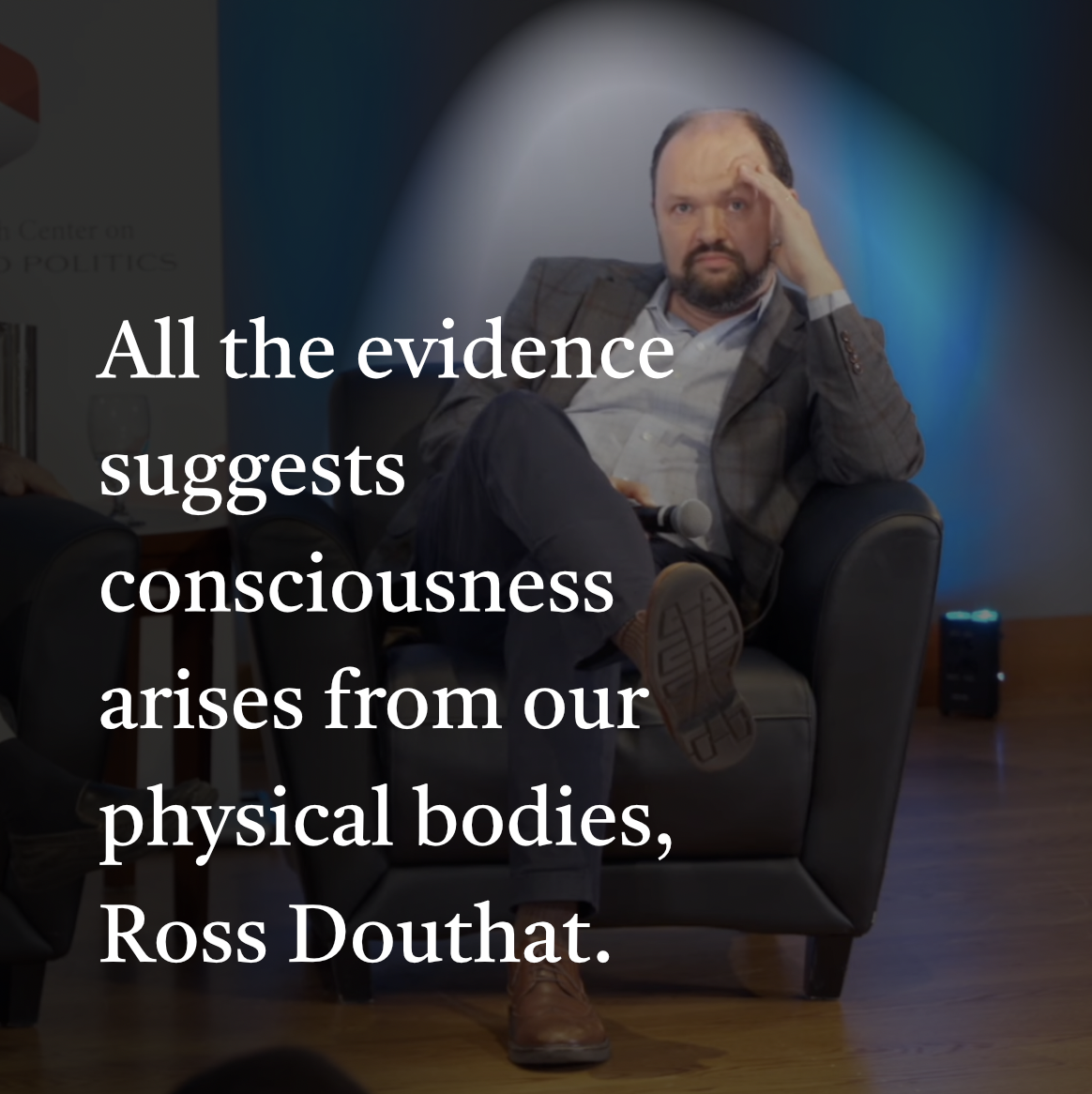
Full Transcript:
Welcome to Not Everyone Believes Ross Douthat. This is a podcast that goes through a book that was written by a man named Ross Douthat.
The title of the book is Believe: Why Everyone Should Be Religious. It claims to be an argument, a proof that religious belief is the most rational thing you can do, that it’s perfectly reasonable, even logical.
So far, there hasn't really been any logic in this book. Logic is a very precise and formulaic thing, and Ross Douthat is not writing in that way.
He's attempting to write persuasively, asking us to take a rational approach while not really engaging in a rational approach himself.
Chapter two, which is where we're going now, in the pages 40s through 50s, is a perfect example of that. Ross Douthat is essentially engaging in a kind of whataboutism when it comes to belief in the soul.
In this chapter, called the Mind and the Cosmos, he's writing about consciousness. He is proposing that consciousness is a supernatural thing. He claims that consciousness is not material, even though it's connected to the material, obviously, though somehow there's something more to it.
I want to start out this podcast episode by talking about a couple things that Ross Douthat actually gets right in this chapter. The first has to do with acknowledging that consciousness is mysterious and remains mysterious.
What does that word “mysterious” mean? It means that there's a mystery. It doesn't mean that you've solved the mystery. You don't have an explanation with a mystery.
Think about it as like a murder mystery, the first two chapters of a murder mystery.
In the first one, the murder happens, and in the second one, a bumbling police sergeant comes in and says, “Whoa, clearly, it was this person over here who did it!” Then we find out that actually the facts do not support that perspective, or that this accusation doesn't seem to be adequate. There's not complete evidence for that. In this case, there might be two bumbling police detectives, so we might have a third chapter.
Let me explain what I mean. First of all, there's the acknowledgement of the mystery. This is where Ross Douthat gets it right, when he writes that consciousness is mysterious, and you can't say that we understand everything about it. It is weird.
Consciousness is not something that we can directly see in somebody else out there, whether it's a human being or another kind of animal. Consciousness is more than the mere observation of wakefulness. Consciousness is not just the sense that we clearly see that that person or animal has roused itself from sleep and are awake in that sense
Consciousness is the experience from the inside of being, within a frame state of mind. It is subjectivity. It is what we call Qualia. “Qualia“ is a great word that Ross Douthat uses. It refers to subjective experience on its own terms, what it feels like to be something with consciousness.
These descriptions are awkward. It's challenging to describe consciousness because consciousness is not itself a physical object, and Ross Stouthet is right in pointing that out. You can't pick up a cube of consciousness. It is something that happens that emerges from of our physical bodies, but as a mental awareness, not a substance.
By the way, it’s not just the brain, but the entire rest of the body with the nervous system and hormones that support consciousness. Consciousness has a foundation in the physical sensations that you have throughout your body. To reduce it to something that happens only in the brain is simplistic. The whole idea that consciousness could exist only as a brain in a jar is missing quite a bit about what consciousness really is.
Of course, it could be that if you could put a brain in a jar and keep it alive, there might be some kind of consciousness going on in there. We really don't know because nobody has ever been able to do that, so let's put that off to the side because that's outside of the realm of anything that we can really examine. It's a thought experiment, but highly speculative.
The point is that people experience consciousness directly. Nonetheless, there is a barrier to fully communicating about consciousness, or understanding it directly in other ways. Much of the grist for romantic comedy and drama arises out of that gap.
You can't know another person's consciousness. You can't even know your dog's consciousness. We see signs of it. We see other people acting as if they have consciousness, but we can't know it directly.
We can't do a mind meld like in Star Trek with Mr. Spock the Vulcan. That's science fiction. It's not real. There is no evidence of actual psychic powers.
In fact, scientific experiments have routinely found that any kind of results that indicate psychic powers cannot be replicated. There is evidence that psychic powers do not exist.
The inability to reach out and share consciousness directly makes it really difficult to talk about to understand what consciousness is. That’s why people have struggled with discussions of consciousness for many thousands of years, going back to ancient philosophy.
There are people who seek to dismiss consciousness as an important question, saying that it's just an illusion, but in fact, consciousness is maybe the most important question of all.
Of course there are other important questions. I'm not going to get into an argument about what the most ultimate question really is. That's an argument for somewhere else with somebody else.
Consciousness is a very important topic to consider. One of the reasons for that is death. Death is coming, and in the meantime, pain and suffering is a considerable portion of conscious experience.
What’s important about that is that pain is embodied. Pain can happen in a mental sense too, of course. There can be emotional suffering, purely within the consciousness, but more directly, we experience pain when things happen to our physical bodies. There is a connection between the physical body and our consciousness. It is the most urgent thing in our consciousness to avoid suffering, to escape hunger, escape sleeplessness, escape torture, physically, because it affects our body and affects our consciousness.
So, we have the first chapter in our murder mystery. In this first chapter, the mystery is identified: What the heck is going on with consciousness?
Now, in the second chapter of this murder mystery, religion shows up and says, “There is a soul, and the soul exists completely separately from the body, and it’s created separately. It can float outside of the body, and it can you know, exist as a ghost after you die.”That's the first bumbling police sergeant coming in to the story. Upon any kind of examination of what that religious police sergeant is saying, however, we have to respond with the recognition that there isn't any evidence of a soul that is separate from the body, distinct from it, something that can survive death.
We have no physical or other reliable forms of evidence, no substantiation for that. The soul as a seat of consciousness is a baseless assertion, a claim without corroboration.
There is a second bumbling police sergeant that shows up at this point in the mystery, however. This second character claims that consciousness is present within anything that replicates what humans do. It makes the confident statement that anything that seems to do the kinds of things that humans do must be conscious.
This argument is currently being made when about generative artificial intelligence, what we really should call large language models. Large language models are a little bit more than just stochastic parrots now. The latest iterations of LLMs have things like calculators added into them, along with a few other bits of software that mimic human language or coding in computers.
They simulate online behavior. They imitate us, but the thing is, we know that these are just kind of mathematical models. They generate output that is plausible, that seems right. However, an imitation is often not the same thing as what it imitates. For example, if you take a pen or a pencil and a piece of paper, and you make a drawing that looks like a person, that doesn't make the drawing a person itself. It certainly doesn’t make the drawing conscious.
There is no indication that there is anything at all conscious about artificial intelligence. Ross Douthat kind of discusses this issue in this second chapter, of his book. Some of what he has to say is on target. It really is ridiculous when people claim that ChatGPT or Anthropic’s Claude are conscious.
We have no evidence that generative AI is in any sense conscious. In fact, all of the reasonable understandings what these systems do and what they are indicates that they are merely very fancy, very sophisticated pieces of software. They imitate other things, just as a drawing can imitate the three dimensional world without itself having three dimensions.
Now we come to the equivalent of a fourth chapter in the murder mystery… metaphorically. In this fourth chapter of the murder mystery, the first police sergeant comes back and says, “Aha! You see, artificial intelligence, isn’t conscious! And you know what's more? I've got more things to talk about! I've got more evidence that the soul is, in fact, the explanation for consciousness.”
The police sergeant continues: “Did you know that biologists and neurologists have not ever been able to fully explain all of the ways in which consciousness originates in the human brain? Therefore, consciousness must be a soul!”
This outrageous leap of faith is like what Ross Douthat writes in the second chapter of Believe: Why Everyone Should Be Religious. He is claiming because scientists have not fully explained consciousness and its relationship to the physical body, the idea that consciousness arises in a soul must be true.
The fact is that we have a huge amount of science that shows the relationship between the body and consciousness. Ross Douthat even acknowledges this.
Douthat admits that, yes, it's true that when you drink alcohol, it changes your consciousness. He admits that even when you drink coffee, it changes your consciousness. That much is undeniable.
Douthat doesn’t mention this more extreme example, but it’s also true that if you shoot somebody in the head or chop their head off, or if you otherwise destroy parts of the brain, that physical change affects consciousness.
What’s more, we know that permanent destruction isn’t necessary. The presence of physical pain in the body affects a person’s consciousness. It compromises the ability to think clearly.
We know that there has never been a person whose body has been destroyed, who has had their consciousness survive. There is never been any evidence of the survival of consciousness after death that has been substantiated, that has been shared between people in a way that can be replicated, that is anything more than storytelling.
People can tell all kinds of stories. I can tell you stories about a dragon who lives under my bed. Telling a story doesn't mean that it's true. Saying that you saw something isn't good enough. For evidence in a reasonable court of law, you would never convict anyone of a crime on merely on the basis of one person's accusation. It's just not a reasonable foundation for certainty of knowledge.
We fear death because all the evidence that we do have is that once death occurs, once the body stops working, consciousness goes away completely. There is no kind of visible soul that rises out of the body and floats around the room and starts talking to people. There's never been any video, no photograph, no audio recording of such a thing.
All we have are stories that people like to tell. Those stories are not evidence. Saying that you see fairies out in your garden isn't evidence that fairies exist. It's just one person's claim.
Restating a claim as if that claim in itself is evidence is not reasonable, but that's what Ross Douthat does with his claims for the literal existence of a soul.
Ross Douthat’s argument is essentially is to say that because science can't explain everything about consciousness, the religious claim that consciousness is in a spiritual soul must be true. Ross Douthat makes this argument in spite of the fact that there is absolutely zero evidence for the religious claim for a soul, and there's lots of evidence for the physical basis of consciousness.
It is true that we don't understand everything about the physical foundations of consciousness. We don't understand how consciousness is related in all of the details to the brain and the brain's interface with the body.
We don’t even understand everything about individual neurons. We used to think there were just a few different kinds of neurons in the brain and then you had their connections and that was all there was to the architecture of the brain. Recent genetic analysis, however, has discovered that there are thousands of different types of neurons in the brain doing different kinds of things, interacting with each other, building dynamic connections, severing those connections in a living, complex way that is just wild. The number of kinds of neurons is far beyond what we had previously recognized, and the number of neurons that we have in our bodies is astonishing. What’s more, those neurons interacts with other signals within the body, chemical signals and hormones. All kinds of interactions are going on in the body, in a complete system that makes it extremely difficult to understand how it all works.
We do know that consciousness is very strongly affected by what happens in the body. If you've ever had a family member who has dementia, you understand what that physical connection is really all about, because you watch that person's consciousness crumble. You watch it fall apart bit by bit, and no matter how many magical rituals you do, no matter how much you pray, it doesn't get better.
It is one of the huge remaining challenges in medical science to overcome that. I don't think that anyone who is reasonable would say that there are no more things left for science to discover, to understand, no problems yet to overcome. Dementia is definitely one of those. Brain damage, recovering from that is one of the most difficult things that a person can go through.
On page 53 of his book, Ross Douthat at first appears to acknowledge this, that, yeah, when it comes to the gaps that remain in scientific knowledge about the relationship between the physical body and consciousness, and the way that the body seems to produce consciousness, not everything has been solved. Douthat writes, “This doesn't prove that consciousness is supernatural in the sense of belonging to a different order of existence than our universe. It doesn't prove the existence of an immortal soul transcending time and space.”
That’s great. That’s like, in chapter 4 of our metaphorical murder mystery, the police sergeant saying, “Oh gosh, this doesn't really provide positive evidence for who the murderer is.”
But then, in the very next paragraph, Ross Douthat contradicts himself. He says, “After 500 years of scientific discovery, consciousness still looks just as supernatural in the colloquial sense, meaning supermaterial or superphysical, not just another arrangement of atoms, but a distinct irreducibility of some kind acting on physical reality without being physical itself.”
Then on page 58, Douthat says, “In the end, the idea that we have available some clearly more rational or scientific alternative to a naively super under a supernatural understanding of the mind is itself fundamentally naive. Whatever consciousness may be, soul or mind, dream or spell itself evidently has its own integrity, its own being which is intertwined with physical reality without being reducible to physical substances, and their interactions.”
Then Douthat continues, writing, “The soul may not be exactly as ancient religions imagined it, but under any conceivable paradigm, it will always be very much alive.”Douthat is arguing that “the soul” is not exactly what ancient Christians claimed that it is, but it is there, absolutely.
That's where Douthat goes wrong.
There is a certain sense to what Douthat is saying, to the extent that consciousness clearly is not an object. Consciousness is an experience, and we know experience is real because we experience directly. As far as he goes there, he's correct. He's saying that experience is something on its own level that is not physical. That’s fine
You can't go into the brain and say consciousness is in this little specific part of the brain, or that consciousness is this neuron there. What we do know that consciousness is not contained in a specific place inside the body or the brain.
However, consciousness seems to be something that that arises out of the relationship between different parts of the brain and the rest of the body. This is where we get into the concept of emergence, which Ross Douthat has a very narrow view of. He dismisses emergence in a kind of ignorant way by reducing it to something merely mechanical.
Douthat always wants to reduce the body to a machine instead of building an understanding of something more complex, so he uses the idea of a car. He writes that the relationship of motion to the physical body of a car is an emergent property, so that you can't take any part of the car and say that part produces motion. However, when you put all the parts together, they create motion.
Actually, that's not precisely an example of emergence because actually you can take any part of a car and you can throw it. You can throw the steering wheel, and then you have motion. Motion can be present as an aspect of any one of the parts of a piece of machinery. It's not like motion itself is created by a set of complicated bits of machinery. Motion is something that’s already in existence, and in fact all things in the universe are constantly in motion of some kind. So, Douthat’s mechanical example provides a completely inapt explanation of the concept of emergence.
Instead, think of emergence in terms of water and hydrogen and oxygen. If you take hydrogen and oxygen atoms, you experience them as a gas. Hydrogen is a gas. Oxygen is a gas. However, if you bring them together, and they form a molecule, that molecule is not just more complicated. It is more complex, and that molecule, when combined with other molecules of its kind, represents emergent properties in H2O. You have the hydrogen and oxygen atoms coming together to make the water molecule, and water behaves in ways that hydrogen and oxygen on their own don't behave.
Something new arises because there is a new level of complexity, not mere complication. It's not a mechanical thing that is being done, so you can't say that the wetness of water is in the oxygen, but not the hydrogen. In fact, wetness is not in the hydrogen or the oxygen. It's in the relationship between them.
The idea of emergence within consciousness is like that.
We find consciousness only in physical living biological bodies. Of course, there's a level of complexity that is lacking from a bacterium. A bacterium is a single cell. A neuron is a single cell. What we have in the human body are huge, huge numbers of cells that are interconnected. So, the macroscopic organism is at another level than what a microscopic organism can produce. There seems to be something in the connection between these cells and the way that they interact with each other.
Yes, science has yet to understand all of that and to perfectly model how it all works, because it's extremely complex, but we do know that we've never had a single neuron, or muscle cell, or bone cell, for that matter, any single cell provide any sign of intelligence.
The cells are active but we've never had a communication of a single word from a cell. You never get a neuron that can say the word “banana”, or communicate that or do something like that. That just doesn't exist.
It's when you take apart the connections in the human body that consciousness falls apart. Consciousness exists in the connectivity and complexity. Ross Douthat tries to do away with emergence here, but by using a mechanical example, he fails to even grasp what emergence really is.
That's why his argument just doesn't work, his argument for the soul. He’s plainly off target when he says this: “In the end, the idea that we have available some clearly more rational or more scientific alternative to a naively supernatural understanding of the mind is itself fundamentally naive, and that is blatantly false.”
We have a huge body of scientific knowledge, experimentation, and observation that clearly links consciousness to the living human body. We see signs of consciousness in others, we have people going through brain surgery and describing the changes of consciousness that take place when brain surgeons are working on their brains.
We also know the effects that substances have on consciousness. We understand some things about what it feels like to be getting sick, to be approaching dementia, and slowly have the mind die.
We have a lot of knowledge about how these things happen, so when Ross Douthat says that we don't have more rational or more scientific understanding of consciousness as a physical property than we have of supernatural activity, that's just not true.
There is zero evidence of anything like a soul. There is zero evidence of any, any, any study that that finds a soul existing at all.
Compared to that, we have the equivalent of huge libraries of knowledge, of scientific, rational understanding of how consciousness is physically based.
Ross Douthat glances over all of that, and says that because scientists don't understand everything about consciousness, that because there are mysteries about consciousness remaining, there must be a soul. He argues that because it's a really difficult to investigate makes consciousness happen, there must be a soul.
It’s true that mystery remains, but that mystery is not evidence for the existence of a soul. Ross Douthat claims that because scientific knowledge of the physical basis of consciousness is not absolutely complete, scientific knowledge itself is “naive”, and none of the evidence matters, and that we ought to just believe what religions tell us about there being a soul that is completely separate from the body. He says, without evidence that we should just belief that a soul exists and somehow floats around and is eternal and is related to magical spirits like God and Jesus and demons and angels and ghosts and fairies and genies and witches.
It's just not plausible. That's why not everyone believes Ross Douthat.