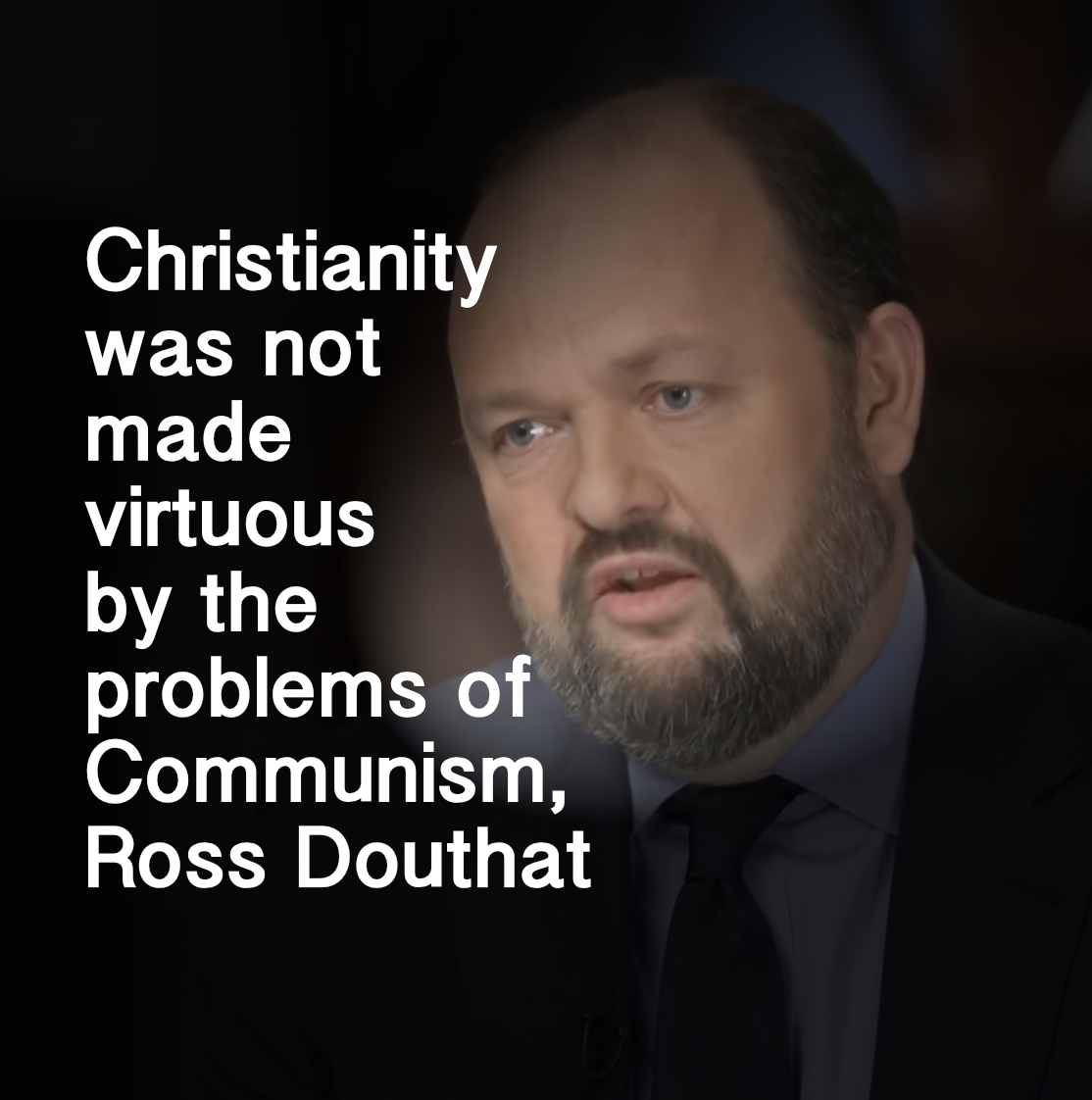
There is a book, written by Ross Douthat. Ross Douthat is a right wing extremist, Christian political commentator.
The title of his book is Believe: Why Everyone Should Be Religious. At the core of the book is the claim that everyone should believe in religion, without exception. Ross Douthat believes that all people should do the same thing.
This podcast stands for the opposite idea. That’s why this podcast is called Why Not Everyone Believes, Ross Douthat. This podcast is dedicated to the idea that we must all be free to seek out truth as we find it, not to surrender our free will under the belief that other people must see better, think better, know better than we do. While Ross Douthat worships conformity to just one Truth, this podcast observes the truth that not everyone is willing to go along and meekly believe what they are told to believe.
In this podcast, I read through Ross Douthat’s book, a book that Douthat wrote to support the agenda of Donald Trump and his Christian Nationalist allies to make Christianity the law of the land. Donald Trump says that the United States is a Christian nation. In order to promote Christianity above all else, Donald Trump brought American democracy to the brink of destruction. The political theology of Christianity, after all, is one of absolute authoritarianism.
We find Ross Douthat struggling with this thoroughly documented involvement of Christian institutions in the worst of human depravity as we read on through chapter 6, in which Douthat claims to address three stumbling blocks to belief in Christian religion.
As he writes about these stumbling blocks, Douthat merely sets up straw man versions of these. He fails to confront the most powerful objections of nonbelievers.
The second stumbling block is really just a new version of the first stumbling block Douthat wrote about, which we discussed in the previous episode. That first stumbling block was: Why does God allow wicked things to happen?
The second stumbling block that Ross Douthat identifies in this chapter is a subset of the general cruelty of Christianity: Why do religious institutions do so many wicked things?
It's interesting that Ross Douthat doesn't get too specific about the wicked things that religious institutions do. He doesn't talk about, for example, Roman Catholicism's history of massive amounts of child abuse. Ross Douthat doesn’t mention the role of Catholic priests in enabling that abuse, covering it up, and resisting attempts to provide justice to the victims of Catholic violence.
Ross Douthat doesn’t talk about the Catholic Church’s history shutting women up into convents involuntarily, and putting their children into cruel institutions where they were slowly starved to death. In these Catholic institutions, children without adequate heat and clothing, and weren’t given enough to eat. The results were predictable. Huge numbers of children died at the hands of purposefully neglectful priests and nuns. Mass graves containing the bodies of large numbers of children and infants who died in these Roman Catholic institutions have been discovered.
Ross Douthat doesn’t name most of the brutalities that Christianity has inflicted upon its victims, and when he does, he avoids describing the scope of Christian cruelty.
Every now and then, for example, Ross Douthat mentions the Spanish Inquisition. He doesn’t ever explain what it was, or what it involved.
The Spanish Inquisition was a program of systematic religious violence organized by and perpetrated by the Catholic Church. It was related to similar programs of persecution that took place in other Catholic countries.
The Spanish Inquisition took place after a bloody religious war through which Christians engaged in genocide against Muslims until not a single Muslim was left alive on the Iberian Peninsula.
Next, the Spanish Catholic Church turned its hateful religious ideology against Jews, forcing Jews to flee Spain, to convert to Christianity, or to be tortured and killed. The Christian king and queen of Spain then sent ships across the ocean in order to torture, enslave, and kill more non-Christians, after robbing them of their lands and possessions.
None of the barbaric Christian atrocities I’ve described so far were part of the Spanish Inquisition. No, they were merely precursors to the Spanish Inquisition.
The Spanish Inquisition began after Spanish Jews were forced under the threat of violence to convert to Christianity. The trouble with converting people to a religion through force is that it’s difficult to believe in the sincerity of the conversion.
How could the cruel Catholic rulers of Spain know for sure that the Jews they had threatened to kill had really become Christians, instead of just saying that they had converted to Christianity? Subtle minds might have pondered the implications of the superficiality of Christian faith, but the Christian rulers of Spain did not have subtle minds.
They decided that torture and death were the answers. The Spanish Inquisition began as a way violent persecution of Spanish Jews who had converted to Christianity, to treat them horribly just in case they were fake Christians. The Inquisition went from town to town, seeking out Jews who failed to display sufficient amounts of Christian faith.
A thought occurred to the Spanish Catholics as they tortured and killed Jews in the name of Jesus. No, they didn’t think to themselves that they were making their religion look bad. Instead, what they thought was: If Jews can fake being Christian in order to escape persecution by our Christian kingdom, other people might be faking their Christianity too.
So it was that the Spanish Inquisition broadened in scope. Now, it wasn’t sufficient to be just any kind of Christian. If people were suspected of practicing the wrong kind of Christianity, they were branded as heretics, and were tortured until they confessed, and then killed.
Historians disagree about the exact number of people the Christian kingdom of Spain brutally murdered during the Spanish Inquisition, but there is no doubt that there were large numbers of victims, enough to terrorize the entire population of the Iberian Peninnsula.
The Spanish Inquisition inspired Christians all around the world to torture and kill their neighbors in the name of Jesus. In England, Bloody Mary burned Protestants at the stake. The Salem Witch Trials in the Colony of Massachusetts were a Protestant echo of Catholic brutality.
Ross Douthat doesn’t discuss any of this. Even as he claims to be objecting to the suggestion that that Christian churches have done bad things, Ross Douthat fails to talk about the many bad things Christian churches have done. Ross Douthat doesn't get into the details of Christianity's systematic, centuries-long involvement in fraud, financial mismanagement, exploitation, murder, slavery.
Ross Douthat doesn’t work well with conceptual subtleties. He believes in his religious lifestyle so wholeheartedly that he thinks that absolutely everyone should be like him, and be religious too.
The simplicity of Ross Douthat’s religious thinking leads him to dismiss the dangers of religious belief without serious consideration of the long history of his religion’s involvement in systematic cruelty.
In particular, Ross Douthat doesn't want to confront the relationship between fascism and Christianity.
On page 163, Ross Douthat says, well, if you think that Christian violence is bad, well what about the brutality of the 20th century?
Ross Douthat writes about,
“Communism, nationalism, fascism, all causes untainted by the dogmas of revealed religion, and yet somehow, much more pitiless than the Christendom they overthrew.”
So you think that Christian wars were bad? Well, what about the Communists? What about nationalists? What about fascists? They weren't Christian!
With Communism, what Ross Douthat says is absolutely true. Communism is ideologically not Christian, not religious. Non-Christian Communism has been horrifically brutal in many places.
The brutality of Communism, however, doesn't absolve Christianity of its problems.
In this chapter, Ross Douthat engages in a form of whataboutism, an immature debating tactic. People who engage in whataboutism when they are unable to deal with an accusation. They attempt to distract from a valid accusation by turning it around, and saying, “What about the bad things other people have done?”
This tactic of distraction is not rational. It’s not reasonable. The fact that Communism has been a problem, totalitarian, brutal, nasty, doesn't mean that Christianity is also not brutal and nasty. To make such an argument is a complete abandonment of logic.
Communism was only one version of authoritarianism in the 20th Century, of course. The other 2 ideologies of the 20th Century that Ross Douthat identifies and says they have absolutely nothing to do with Christian ideology were Nationalism and Fascism.
Nationalism and fascism often went together, by the way, and when they did, they had a hell of a lot to do with Christianity, actually.
Fascism started in Italy as a Nationalist movement.
It’s true that Benito Mussolini was a little bit of an opportunist early in his career. He tried on different kinds of ideologies, but eventually he settled on a Christian Nationalist Fascism that was friendly to Christianity, and was worked along with the Catholic Church to establish cruel Fascist control across all of Italy.
In Germany, of course, there was Adolf Hitler, who was not an atheist. Over and over again, he said, no, I'm not an atheist. Of course I'm not.
In fact, he based his slaughter of the Jewish people, wherever he went, millions and millions of them, the Holocaust on the Bible.
Hitler based that on the example of Jesus in the gospels, when Jesus himself became violent, when he saw that people were changing money in the Temple of Jerusalem. The money changers were engaging in a religious practice that Jesus didn’t personally approve of. So, Jesus violently attacked the money changers in the name of his religion. Jesus grabbed a whip and he started to beat people in the temple, to drive them out.
In Munich, April 12th, 1922, Hitler said the following about the role of Jesus in the Nazi Party:
“My feeling as a Christian points me to my Lord and Savior as a fighter. It points me to the man who once in loneliness, surrounded only by a few followers, recognized these Jews for what they were and summoned men to fight against them and who, God's truth! was greatest not as a sufferer but as a fighter. In boundless love as a Christian and as a man I read through the passage which tells us how the Lord at last rose in his might and seized the scourge to drive out of the Temple the brood of vipers and adders. How terrific was his fight against the Jewish poison. Today, after two thousand years, with deepest emotion I recognize more profoundly than ever before the fact that it was for this that he had to shed his blood upon the Cross. As a Christian, I have no duty to allow myself to be cheated, but I have the duty to be a fighter.”
Adolf Hitler said that that violence by Jesus was the example that told him that he needed to go and kill the Jews, because the Jews were like the money changers in the temple. They were part of a Synagogue of Satan, Hitler said.
That Synagogue of Satan accusation against Jews comes from Jesus, in the Christian New Testament Book of Revelation. Jesus came up with the idea that any Jews that don't follow him are nasty and are evil and are Satanic, and must be exterminated.
That comes from the Christian holy book. The Nazis didn’t make it up from thin air. The Third Reich got the idea for the Holocaust from Christianity.
Adolf Hitler made that connection explicit, in speeches where he explained that he was inspired by Jesus to kill the Jews.
The Roman Catholic Church helped the Nazis as well. There's plain documentation of that.
In Fascist Spain especially, Christianity and Fascism were one and the same. Spain is the place that classic fascism survived after World War II. It’s no accident that the country known for the Spanish Inquisition merged Christian Nationalism and Fascism most successfully, in a form that survived all the way up into the 1970s, 30 additional years under Francisco Franco, the Christian Fascist leader.
Franco was Roman Catholic, and he used the Roman Catholic church and the church's desire to fight communists to justify his fascism.
In fact, the Catholic Church in fascist Spain was an ally of the fascists, was used to control and sometimes in prison and sometimes murder people who were enemies of the fascist state.
The Roman Catholic sect Opus Dei was in particular a part of this connection between fascism in Spain and Christianity. Fascism in Spain was Christian nationalist in the sense that we understand it in the United States of America today, saying that Spain is a Christian nation, and Spain is a fascist nation.
We have to look at what's happening in the United States right now. Donald Trump is fascist. He's got secret police out on the streets, in masks, terrorizing citizens and non-citizens alike, putting people in prison, imprisoning people for doing things like reporting on protests, or engaging in peaceful protests, or daring to question what ice agents are doing out there? We've got concentration camps being set up. We've got terrible things going on in the United States. We're in emerging fascism right now. The ideology that's linked with Christian nationalism claims that the United States of America is a Christian nation.
In 2016, in 2020, in 2024, and now in the midterm election of 2026, the polls of that are associated with these elections clearly show that the people who are voting for fascism to be established and to be continued and to be strengthened are overwhelmingly Christians.
Christians are the majority of people who support fascism and that the majority of Christian voters are supporting fascism in the United States. Only minority of Christians are standing against fascism
The people in the United States who are standing most strongly against fascism and Christian nationalism are atheists.
On page 163 of Ross Douthat’s book responds to these facts with a failed attempt at whataboutism, because most of the very political movements Douthat argues were more violent than medieval Christian governments were also Christian.
As we see in our present day, experience and in the history of fascism in the 20th century. We see that actually Christianity is an integral part of fascism and nationalism, and the violent oppression that they engage with. You can't say that because Adolf Hitler killed a bunch of people, Christianity is to be absolved of its violence. It just doesn't make sense.
What’s more, Christianity clearly fails its own moral standard. To be fair, it’s a fantastically impossible moral standard to uphold.
Christianity doesn’t claim to be merely good. It claims to be morally perfect. It claims to embody a flawless moral vision that is as much an inherent feature of the universe as the speed of light. Given the infinite arrogance with which Christianity announces the transcendent perfection of its moral system, we should set a high bar for evaluating the truth of the religion’s claims.
Christianity demands immense sacrifices from both individual people and society as a whole. Christian organizations and preachers routinely insist that their religion be granted an elite status above the law, and claim an exclusive right to the power to control people’s lives.
Given the high stakes of Christianity’s hunger for power, it’s not enough for Christians to be morally equivalent, or even morally superior, to non-Christians. Christians claim to belong to a perfect religion that was invented by an all-powerful magician who is the very definition of moral goodness. If Christianity is to be believed, it must be morally perfect.
Christianity is the farthest thing from moral perfection. Christianity often leads the way into cruel immorality, and that's why not everyone believes, Ross Douthat.