Not Everyone Believes, Ross Douthat
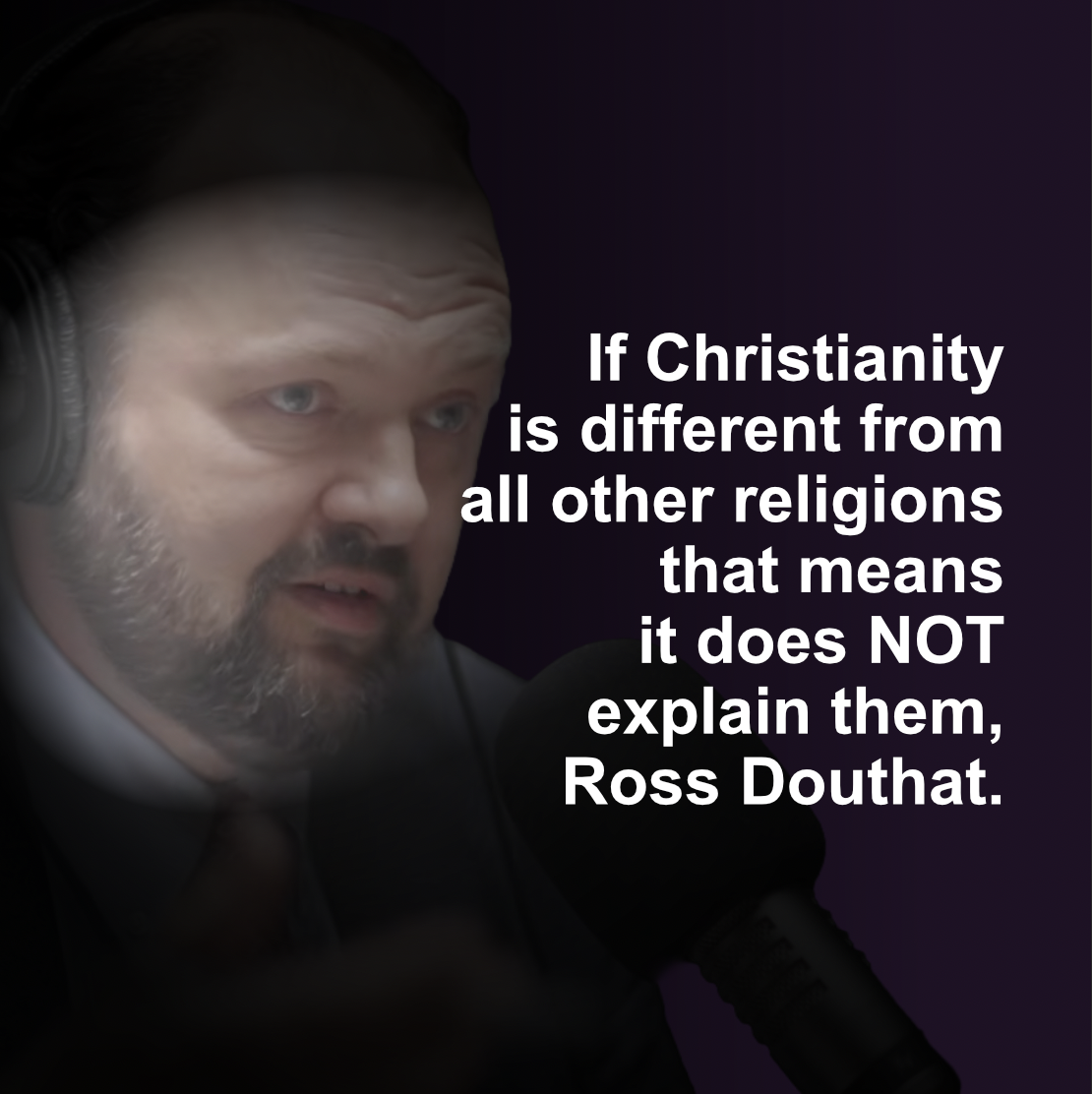
Ross Douthat promised that he was gonna convince us that we need to belong to religion with rational, reasonable arguments and evidence, but on page 193, this is the argument that he's making: Ross Douthat says that Christianity is different from all other stories, all other religions, and therefore, it ought to be the thing that we use to evaluate all other religions, to understand all other religions, and stories.
Does that make logical sense to you?
Welcome back to Not Everyone Believes Ross Douthat.This is a podcast that I have created as I am reading through Ross Douthat's book, with the title Believe: Why Everyone Should Be Religious.
There is a high threshold of evidence that you need to convince somebody that everybody needs to be doing the same thing. If you want to convince every person on Earth, eight and a half billion people, that they all should be doing the same thing and no one should be different, you've got to come up with an amazingly strong line of argument, and that's the opposite of what Ross Douthat has done here.
Let me read to you from, in the last chapter, we have just 13 pages to go in this book. There's a new section in this chapter, called The Strangest Story In The World.
Here's what he's saying.
“I think that God has acted in history through Jesus of Nazareth in a way that differs from every other tradition and experience and revelation, and the Gospels should therefore exert a kind of general interpretive control over how we read all the other religious data.”
He's saying that because Christianity is different, because it differs from other experiences and other religions, other cultural traditions, it therefore ought to be the control.
Ross Douthat is saying that because Christianity is different from other religions, experiences, thoughts and stories, it ought to be the lens, academics might say, it ought to be the interpretive mechanism for which we consider all other religions, all other experiences, all other thoughts and stories.
Ross Douthat is arguing that Christianity should be the center of everyone's universe because it's different from other traditions.
The basic logical structure of this argument is that if one thing is different from everything else, then that one thing should be the standard for the rest of the world. That is the logical argument that Ross Douthat is making. It is a failed logical argument. You can't just say that because one thing is different from everything else, it is therefore the key to understanding everything.
First of all, that difference is really important. If something is different from everything else, then what you're essentially saying is that other things can't be compared to that thing (in the sense that it is not alike to other things). That's not an argument for having that one system be the standard and the way to understand reality for everything else. It's a way of saying that that one thing doesn't explain everything.
Ross Douthat is taking an observation that any rational person would understand as meaning that there is no one True religion, no one True fact, no one True experience that explains everything else in the universe. Ross Douthat is taking that and he's flipping it around to claim that because Christianity is different from all other religions, that Christianity explains everything.
Ross Douthat is implying that Christianity explains why you wanted to have a burrito for breakfast, it explains how socks are made, it explains the stories that are told on Netflix, including Disney princesses. Ross Douthat is arguing that Christianity explains King Arthur, that because it explains everything, it explains the dinosaurs and supernovas.
Ross Douthat claims Christianity can explain everything else simply because it's different.
Ross Douthat loves the story of Christianity. I get it. He's a big fan. He's a fanboy of Jesus of Nazareth.
(Jesus of Nazareth? I don't get why they say that. Everyone just says “Jesus” and you know who it is. If you say Jesus of Nazareth, you're trying to ground him. Okay, he was from a place. Maybe, maybe not. I don't know. There's not some other great big Jesus that everyone talks about.)
Anyway, here's the other thing: If you accept the logical structure of Ross Douthat’s argument, you can turn it around and logically say, using Ross Douthat’s form of argument, that Buddhism, the story of the Buddha, is different from other stories, that Buddhism is different from other religions, and therefore, Buddhism ought to be the way that we interpret everything, that it ought to be the general interpretive control over how we even think about any other religion.
That's kind of nonsense, isn't it? If you're a Christian, you can understand how that's nonsense. The logical structure that Ross Douthat is using, if you just replace Christianity with Buddhism, or Buddhism with Christianity, you can see it's nonsense, it's babble. It's unclear thinking. It's unpersuasive to anybody other than somebody who already shares Ross Douthat’s point of view.
Difference is not an excuse for dominance.
From this point, Ross Douthat goes on for several pages, just saying how much he really likes the story of Christianity, how great it is, and that works for him.
There are a lot of people who think that Christianity is a really awful story. First of all, it's inconsistent. It doesn't have consistent facts. It's not told as if it is a memoir, actually.
Honestly, the character Arc of Jesus is pretty terrible. You have Jesus saying some really nice things now and then, but then he starts to get angry and rageful. Jesus says, I'm going to come back and I'm going to be, when I rule over everybody and I institute my religion, I'm going to be like the master of a household who has his servants killed for failing to follow his directions.
That's a story that Jesus tells in the Gospels. Elsewhere in the Gospels, Jesus goes to a couple of cities and tells the people there, if you don't worship me, you're going to be sorry, and you're going to suffer a massive genocide. You're all going to be killed. A lot of Christians don't like to point out these stories, but they exist.
We've already talked about Jesus storming the temple with a whip in his hand because he didn't agree with the religious practices of some people there, to drive them away. He was religiously intolerant. Then, of course, there's the entire Book of Revelation, which is a story about what the future is going to be when Jesus returns from the dead, finally (which he promised to do really quickly, and then he never did. That's a big problem in this story, isn't it?)
The last book of the Bible says Jesus really will return, and it really will be soon, and when he does, he's going to engage in a series of violent attacks upon not just people, but even killing animals who never did anything wrong to anybody. Jesus is going to destroy the earth.
For the planet Earth, if you imagine an alien invasion from outer space, it could not possibly be worse than what Jesus threatens to do to our planet and to the people on it. At the end, there's going to be maybe a little bit less than 150,000 people of his True followers who he's going to let them live. Then he's gonna have a reign as an undisputed tyrant over the entire Earth.
That's not turning the other cheek. That's not peaceful. That's not loving your neighbor. It's killing your neighbor.
The story of Jesus is the story of a guy who tried to be nice a few times and then failed and became a narcissistic homicidal maniac. That's not a great story. We need to be honest about that entire story and not just pretend that the Sermon on the Mount is all that's in the Gospels.
Ross Douthat never talks about that stuff in this book. He never acknowledges that Jesus was a terrifying person who tried to inspire people to follow him, to inspire obedience through fear.
Honestly, I don't want to interpret the world according to that. I think a lot of other people don't want to interpret the world according to Christian terrorism and fear.
That's why not everyone believes Ross Douthat.