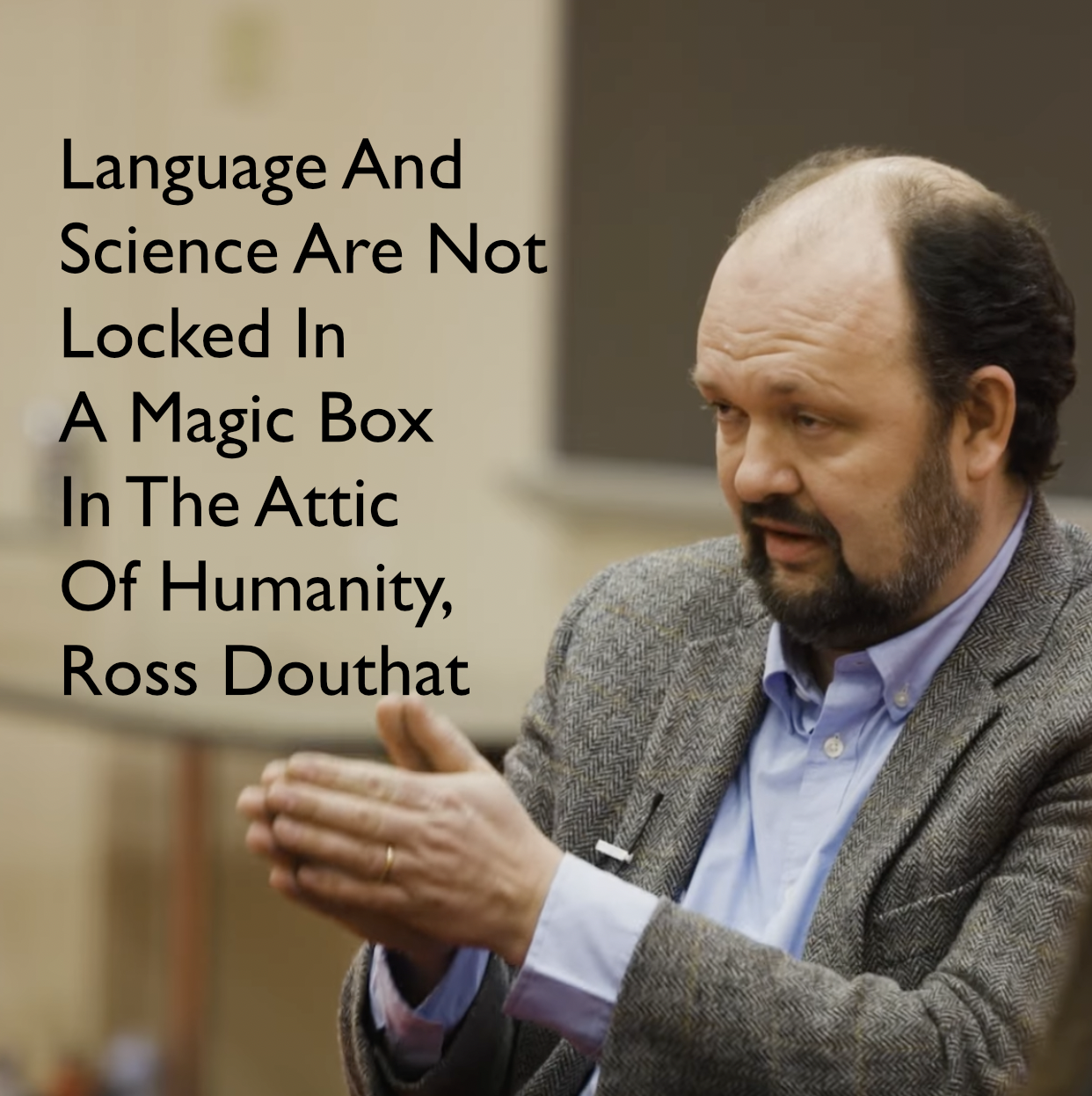
In this episode, Ross Douthat tells a weird story about science being like a secret book written by God in a coded language that little kids invented to avoid being listened to by their parents. That is the unhinged fantastical kind of thinking that Ross Douthat claims is “rational” in his book Believe: Why Everyone Should Be Religious.
Science is a systematized way of building confidence in knowledge. It’s a way of establishing a rigorously complex culture. In this sense, science is not something that began during the Enlightenment. Present day science is not an odd departure from ordinary human behavior. It’s a progressively well-developed form of an inherently human way of being.
Of course, religion is also an expression of an inherently human form of behavior. In every culture we know of, there have been bizarre, irrational systems of belief and behavior. Often, these systems promote downright self-destructive behavior, as is the case with Christian practices of flagellation. Humans are weird. Our weirdness seems to be a side effect of our capability for symbolic thinking.
Ross Douthat seems not to have considered that the ideas and practices of his religion could be merely symbolic. Instead, whenever Douthat comes across a bizarre story of spirits, monsters, or gods from Christianity, Douthat’s first reaction is to assume that it is literally true. It’s as if human culture has told a joke, but no matter how many times it is told, Ross Douthat just doesn’t get it.
Of course, Douthat does not assume the same literalist assumption for other people’s religions. He’s so lost within the supernatural stories he grew up in that he is unable to recognize his religion’s obvious fantasies. Instead, he reinterprets literal physical reality as just a magic trick played by a cosmic wizard he knows by the name “God”.
Ross Douthat’s argument completely misunderstands how language is works. Language is not just a tool of communication. It is a tool of thinking that is developed in relationship to the world. So, any language that people invent and use, relates to the world. It isn’t just an abstract code. Language is a continually reinvented system of thought and communication that gets used only because it relates to the world.
Science emerged as a very precise form of language. Science is not just a book of knowledge. Science certainly isn’t a transcendent book of esoteric knowledge written by a spirit and then hidden in an attic somewhere to be discovered by humans when they become mystically mature.
Full Transcript:
Welcome back to Not Everyone Believes, Ross Douthat. This podcast is a reading of a book by Ross Douthat., who is a right wing Christian pundit on 60 Minutes. His book is Believe: Why everyone should be religious.
Everyone. Everyone should be religious, no one should not be religious, is what he's saying.
Anyway, we are on page 60 now. In the second chapter, which is all about consciousness, and you could kind of sum up this chapter as a Christian version of 2001: A Space Odyssey.
Remember that old movie? It was a book before that old science fiction book, a not very science-y science fiction book, I have to say, by Arthur C. Clarke.
In that movie, in that book, the whole thing is like, wow, gosh, human consciousness is so amazing, it couldn't have possibly evolved naturally, so there must have been aliens, in the case of 2001.
But here this is a Christian version of that. Ross Douthat. is saying it had to have been a god that created souls, magical souls, and we are all magical beings that are just trapped in these biological bodies because, you know, evolution couldn't have done this.
I mean, what are the chances? What are the chances that you develop a mind like this?
Ross Douthat loves that kind of framing: What are the chances? Gosh, it's so unlikely.
He is Ignoring the fact that the history of life on earth is over billions of years. Not millions, not thousands. Billions of years.
That’s a lot of dice rolls when you have little living things breeding over and over again, sometimes with a very short life cycle of just a matter of days, when it comes to microbes, maybe not even a day, it. The reproductive period is certainly longer when it comes to human beings, but that is a relatively recent phenomenon, the longer lifespan and longer breeding period of human beings as well.
Anyway, Ross Douthat is quoting this guy on page 60, Thomas Nagel,who asks, “Is it credible that selection for fitness in the prehistoric past should have fixed capacities that are effective in theoretical pursuits that were unimaginable at the time?”
Ross Douthat. that is quoting a question there from Thomas Nagel. I wonder, to what extent, does Ross Douthat ever refers to the answers that Thomas Nagel might have explored.
In his book, Ross Douthat is saying, it just isn’t possible for people to have biologically evolved minds that can think about theoretical physics. He asks, how could you have a human mind that is capable of doing computer programming and, you know, sending people to the moon and doing all of this elaborate stuff, making music? How could that mind have evolved from what our ancestors were doing? How could we have people doing complex mathematics and logical arguments?
He focuses on physics, because he loves to think about the metaphor of the universe as a machine. He likes to think that way because that means the machine had to have been made by somebody.
But anyway, the question Ross Douthat is asking is how can human beings be capable of complex thoughts, when they evolved, as, you know, apes out on the savannah, hunting and throwing rocks?
Well, on its face, it's kind of obvious. You have a mind that is capable of making precise calculations of the arc of an object as it travels through space to hit an intended target. I mean, come on. That's a pretty complex kind of thought and people are really good at throwing and catching. That is pretty clearly an adaptive trait.
Everyone can see that connection. Ross Douthat kind of ignores it.
He's also ignoring a larger evolutionary principle, an idea that really isn't that difficult, which is that you repurpose things.
An example is dinosaurs, including birds. We have the fossils showing that a lot of dinosaurs had feathers, you know, but a lot of dinosaurs did not fly. Birds are kinds of dinosaurs that evolved to fly.
So what are those other dinosaurs doing with feathers, and how do you get the feathers there in the first place?
Well, the feathers are not just good for flying. They're not just good for flapping your wings and creating an enormous lift. They're also good at conserving heat, holding the heat and they're like a blanket that you grow around yourself. They have some of that same function as hair.
So you have feathers, which perhaps evolved first, to insulate, to keep the heat in, and then were repurposed.
What happened with feathers was not a conscious decision, but they were available as these interesting outgrowths that then, with a long, long period of mutations, could be repurposed into devices to move air on wings so that you can glide through the air and then fly through the air and steer yourself through the air.
They're also great sexual displays. I mean, why do we have birds that are so colorful? Feathers are displays as well.
Single things have multiple purposes, and something that initially was developed for one purpose can be repurposed.
What if we think about consciousness like that? Ross Douthat doesn't want to look at consciousness like that, but let’s do it.
Look at consciousness as a tool.
We all know one of the basic things that consciousness is good for. Consciousness is a focusing tool.
You keep something in mind. You keep information in mind, but also purpose.
Think about this in terms of the way that it fails us sometimes, because maintaining focused consciousness is hard. Have you had the experience when you walk into a room and you forgot why you wanted to go there because you're thinking about other things? You walk into the kitchen and you realize that you don't know what it was that you were coming to get. What was it? Food? Eas it coffee?
Then you have the thing of reheating coffee in the microwave multiple times because you keep on thinking, “I’m going to remember that,” and you hear the beep and you're like, “Oh, just one minute. I'm doing this other thing. I'm doing this other thing. I’ll get to that coffee in a minute.” Then you realize you forgot it again, so you reheat the coffee again.
That's a failure of conscious attention. Take a look at what's happening in our world. We have a world in which multitasking has become really essential, and yet we're coming up to the limits of some of our conscious ability because we're discovering that too much multitasking actually degrades the quality of our work.
People are being asked to take care of many things at a time. In fact, you could say that's what human beings are specialized in. We are specialized in keeping multiple tracks of ideas going in our minds at one time. We take care of family, we take care of our work. We take care of social responsibilities out in the community, we take care of ourselves. All of those things at the same time.
Now we've got this virtual world that we have developed, we have built. It's like a tool for us to keep information and ideas like a very elaborate notebook.
The online world is not consciousness itself because it hasn't developed the ability to have this self-awareness, this thing that we talked about in the last episode, which is the phenomenological sense of eye and that sense of being a thing. Nonetheless, it is an adaptive trait to be able to hold all that information in a virtual space.
We can think of our human ancestors as primitive, but they were actually engaging in remarkably complex pieces of behavior. They were making art. They were maintaining social connections that were very complex.
They were adapting to exploit different resources in their environment remembering where they were when they show up in the annual cycles of wherever they happen to be living at the time and what the threats are.
You know, they have to think about what are the poisons, all of these things going on, and then they're developing tools. So they're taking things like wood and fibers and stone. They're making things like ceramic and they're creating ever more complex objects that turn in on themselves. There are even indications that prehuman ancestors, australopithecines, made stone tools.
So this is the thing that's happening over millions and millions of years. It's not just something that happened in the last 10,000 years or so. This is going back quite a while, and we have lots of fossils to prove it.
There's no more human missing link in human evolution anymore. We have a ton of fossils, and we can argue about which ones went to where and with what kinds of relationships to different groups and all of that, but we have a lot of information about how all of this happened.
Even recently, just this last week, there was a scientific report that came out showing that Neanderthals were working with wooden tools. They found an actual kind of impression of a wooden artifact in a Neanderthal community. We also know that Neanderthals were also working with art. Neanderthals were not stupid. It turns out, in spite of the whole caveman, Neanderthal stereotype that we used to have about them.
Anyway, the point is, consciousness makes sense evolutionarily, but, Ross Douthat, well, he's not an anthropologist. He's not a paleontologist. Hey, neither am I.
Ross Douthat doesn't see the connection. He thinks that there's a gap. He asks, how can you have an animal that evolves the capacity for thought so that now we're able to do these amazing things and have theoretical physics and chemistry and all of that stuff? It just doesn't seem possible to him.
Ross Douthat has this analogy that he uses. As a way to show how absolutely ridiculous this idea of biologically evolved consciousness is.
He says, “Suppose that as a child, you developed a private language. To use with your siblings or your friends, a simple set of codes slightly more sophisticated than pig Latin, with the eminently practical purpose of enabling private communication that grown ups wouldn't understand. Let that stand for the survival driven toolkit of our primal ancestors.
Then, much later in life, supposed you discovered that this childish system enabled you, and only you, to read and understand a set of ancient texts, as complex as Shakespeare and Aristotle put together, that contained all the secrets of Mayan astronomy, Greek philosophy, and Egyptian mysticism, and that you happened to discover, in the attic of your childhood home.
Would you just assume, well, I was a bright kid and putting one over on grownups really builds linguistic skills, no wonder I was able to read the ancient book of esoteric knowledge that just happened to be hanging around in my vicinity? Or would you accept the more obvious conclusion that you were a character in a larger story, and that the book was in some sense placed there for you?”
Okay, so, wow, there are kids who develop a coded version of a language that already exists, an adapted version of a language that already exists.
And then they find that, gosh, wow, up in the attic, you know, when they're adults, they find, gosh, there's this book and it's written in that same code.
What are the chances of that?
This is not a thing that actually happened. That never happened to kids. Never happened.
If you look at this story, it's kind of bizarre.
Because you gotta think, who made that book? Wait, there's a person who put a book, a code book? Up in the attic? For you?
That's what he's saying is the most logical explanation, is that somebody made that code book for you.
And that's supposed to be an analogy to science and chemistry and all of the amazing thoughts that we have and, or it's not just that, but it's, it's, it's the ability to even think of all of those things that somehow there was somebody who created the coded language for, for you.
It's a weird, weird metaphor, but his whole idea comes down more succinctly to this.
He's asking this rhetorical question. “Why should capacities that evolved because we needed to hunt gazelles and avoid predators also turn out mirabilis dictu, to be capacities that enable us to understand the laws of physics and chemistry, and to achieve man spaceflight, to split the atom and condense all human knowledge onto a tiny piece of silicon. Why should a crudely practical tool set that's helpful for African or Mesopotamian survival turn out to be so extraordinarily elastic in its applications?”
Did you get a little bit of racism there? Why should it be, you know, why should people who lived in Africa have thoughts?
Whoa. Hold on, dude.
I mean, we get the Mesopotamian thing from Ross Douthat because it's like you either can understand that human evolution started in Africa, which it did, and then, you know, but after that, what was important? Oh, the Bible, Mesopotamia.
Anyway, he's doing a couple of things that are really weird.
I mean, first of all, he's talking about the laws of physics. It's if they're laws that were actually written by a lawmaker. That's what he's arguing for in this book that God said, “What are the laws of physics? What should they be? Hmm.” It’s like God had some kind of cosmic pen and pencil, and he started to write them down.
“I know. There should be gravity. Yeah. Okay.” And then God scribbled for a bit. “Okay, there's a law.”
Okay, but that's not what these laws of physics are. What they are is observations.
By calling them laws, he makes it seem like, well, someone had to write something down, and someone had to come up with it because it's laws are written by conscious beings.
They don't just spontaneously appear in nature. If we look at those laws of physics as observations of physics and how they work, all of a sudden it makes more sense.
Ross Douthat is also diminishing what our African ancestors were in another little racist way.
What did they have to do? Ross Douthat says they just had to hunt gazelles and avoid predators. No, they had to do a lot more.
What Ross Dowsett is doing here is engaging in a really outdated form of anthropological armchair speculation called Man the Hunter. That concept supposed that all of our traits evolved because we had to have meat because men were doing the important things, and were out hunting meat.
Actually, people as a species were doing a lot more things, they were gathering crops, they were gathering mineral materials, rough materials to make really complex technologies.
Actually, even way back in the day, tens of thousands, a couple hundred thousand years ago, they were making complex technologies, and they were forming social alliances.
They were making, yeah, really complex plans for how to hunt, but also how to build shelters for goodness sakes.
A lot of this has to do with language.
It's not for nothing that Ross Douthat uses this inapt analogy in terms of language because language is a way of thinking.
It's a way of organizing your thoughts. It's a way of working with ideas.
And forming them into structures that then are doing really interesting technological work, actually.
I mean, it's not for nothing that text and technology sound similar.
They come from a single root word, which has to do with textiles.
If you look at the way that words flow on a page, it's kind of like words or strings flowing to make a fabric.
Technique, a technique in ancient Greek, actually, uh, was uh, related to textiles text, textiles, you're making a textile, you're making a technology.
Do you start to see how all of this works actually?
If you consider what language is and what goes on in the mind in order to hold all of those words and concepts and to be able to juggle them, and then to share them with other people, to then listen to what other people are saying?
To remember that, to reintegrate that, and then share that with other people, Wow, you're starting to get some really amazing stuff.
And it's quite clear what the adaptive advantage of that is, you can start to make long-term plans.
You can share stories that contain information that you can start to develop really complex cultures.
You can start to take care of each other as people and provide, and go beyond the simple hunt, eat, sleep, kind of model that Ross Douthat is thinking about.
That's the thing: What is theoretical physics?
What is the ability to build computers really all about?
These are extensions of The invention of the clay pot, of the woven textile net that enables you to catch fish.
These are continuations, not in some kind of strange gap.
These are extensions of what human beings have been doing all along, and even before we were human, our non-human ancestors were engaging in some basic work with language and were making tools that are much more complex than what chimpanzees can make.
This has been going on for a very long time. It's taken a long time for us to get here, but it's not like, oh, you just make up a code.
You make up a language, and then all of a sudden, bang, there it is, right, and all of the information is just there for you as some kind of gift.
That's not how science works.
Language is a tool for thinking that developed in relationship to the world.
That's another part of Ross Douthat’s analogy here that makes no sense.
The discovery of a book that was written, and it's just up there in the attic later on, as if that's science, and all of our scientific understanding is if scientists just discovered it, and it was already there for them.
That's not how science works. Scientists made science. They made science through trial and error, experimentation.
Observation, and a lot of failure in doing that and cooperation together through language.
It's not just that they made some code. They made some code to understand things.
The people, if you want to look at science as a book, people wrote the book and we have a history of how that happened.
There's no mystery in that. We have the written down history. We have records.
I mean, of course, you know, every now and then there was a fire and some papers were destroyed.
We have a nearly complete record of how scientific discovery progressed, and archaeologists have been digging back, and they've been finding the evidence, evidence like the wooden tools from the Neanderthals of how technological advancement progressed over time.
There is no gap.
There is no mysterious appearance of a book that tells us everything.
Wow, like God made this for us.
It just hasn't happened.
You know what happened, according to the Christians. Is that God essentially wrote, and you know, okay, I know there are disagreements, that some say it was people who were inspired by God or whatever, but it is supposed to be the word of God, the Bible. That's their book, and you know what it is?
It's wrong. It's wrong about the science. It's wrong about the history, and its morality is, you know, very... Bronze Age. It's not exactly up to date. It doesn't stay true to the times.
So, this whole analogy is actually just a warped reflection of the way that Ross Douthat thinks about the Bible, and he thinks that it's got all of the wisdom and all of the knowledge that we need, and that's been provided by God.
That science is just really kind of extra stuff, you know.
Ross Douthat once again misunderstands what consciousness is. He misunderstands how information and learning and science works, and he makes an argument that has no logical sense to it.
The idea that somehow magically there was a spiritual being who created science for us, but made us wait for hundreds of thousands of years for it to be delivered, and wow, that somehow matches our language.
It just doesn't make sense.
We have the evidence right before us.
People are clever, people work with great patience and cooperation year after year to build collaborative systems of knowledge based on what they can observe in their environments.
They share that. They work with it over time, and over time, that became science. Science has become more and more sophisticated as we have developed more technologies to observe the world around us
As we have observed that world, that universe out there, do you know what we have never found?
We've never found ghosts. We've never found demons or angels or heaven, or hell, and we've never found God.
That is why not everyone believes Ross Douthat.