Nonbelief Is Bigger Than Regret and Christianity, Ross Douthat
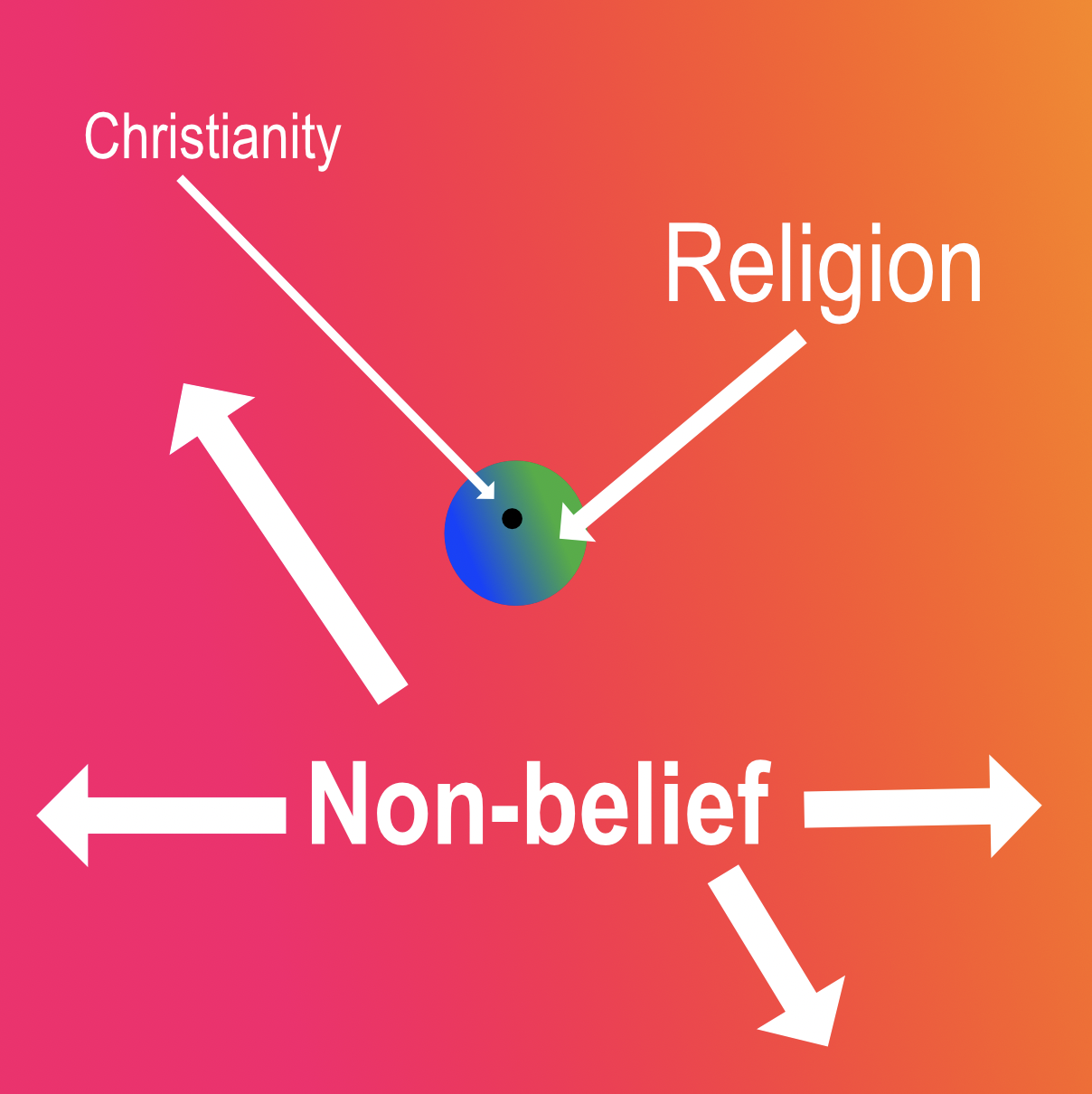
The conceptual space of Christianity compared to religion in general compared to non-belief
Welcome back to Not Everyone Believes, Ross Douthat. This is a podcast that goes through this book that was written by Ross Douthat, who is a right wing Christian commentator on CBS 60 Minutes, a show that itself has been taken over by right wing content. It's now a MAGA show, no longer the solid journalistic production that it used to be.
The last episode of this podcast covered something on page one of the introduction. Now, we're going to go on to page two of the introduction of Ross Douthat's book, Believe: Why everyone should be religious.
Everyone. Imagine that, a world in which there isn't one single person who disbelieves religion, who has a skeptical thought, who thinks outside of religion. Imagine everybody on earth thinking inside the religious box. How dreadfully boring that would be.
I want to think about that religious box, and the Christian box in particular, in terms of what Ross Douthat is bringing up here.
Ross Douthat has this depiction of non-belief, non-religious life, non-Christianity, which is that it's just plain miserable. It's full of what he calls “regret”.
Ross Douthat presents this idea of regret, regretful atheism, regretful non-belief, which he says represents a whole bunch of different kinds of communication that he got from people. Douthat says that they’ve told him, “I'd happily go back to church except for one small detail. We all know there is no God.”
So, in Ross Douthat’s book, we have this idea that people would love to be going back to church, only, gosh darn it, God is a pretty ridiculous idea. This claim sets up what Ross Douthat is doing with this book, which is to address just one argument that he imagines represents a whole bunch of people: That they would love to be religious, and they would love to be Christians, only it’s just, oh gosh, they would feel kind of foolish, because Christianity expects them to believe in supernatural, irrational, magical nonsense.
On the top of page three of the introduction, we see Douthat describing this premise in terms of a kind of cultural type that he imagines, and he makes fun in his writing. He says, “There is also often a shopping, a stopping short. A sense that any reconsideration of religion still runs up against the limits imposed by being a Serious Modern Person Who Doesn't Believe In Magical Nonsense.”
Ross Douthat, on pages two and three of his introduction, is arguing that the reason people are leaving Christianity, and leaving religion behind, is simply because it's just irrational, magical, superstitious nonsense.
I want you to notice one little thing that Ross Douthat is doing in this assertion that he does over and over and over again. Although he says that in this book he is just talking about religion in general and he's not trying to get everyone to become a Christian, right in here in the introduction to the book, he's talking about church, in this idea of a person who would happily go back to church except that we all know that there isn't a God.
This is something Ross Douthat does over and over and over again. He reveals his rather narrow perspective, his lack of breadth in understanding what religious life can be. It's that lack of breadth, a lack of representation of all the alternatives that I want to address in this short episode of this podcast today.
Ross Douthat is saying that atheists are miserable, especially those who used to be Christians and used to go to church, not to temple, not to synagogue, but to church. There’s the idea that they're just regretful. Ross Douthat says that's what he saw in the letters people sent him.
Of course, this might be the selection of people who would even bother to try to get in touch with him. We have to think about the kind of people who wouldn't try to do that.
I'm not saying that there are no atheists, no former Christians who are regretful about that change. Leaving behind an identity, a cultural identity, such as Christianity is a complex and difficult thing.
I happen to know, however, having been in touch with a whole bunch of different non-religious people, both ex-Christians and people who come from other traditions or from non-religious upbringings, that actually a lot of people are really, really happy, that they don't have to deal with the nonsense of Christianity or other forms of religion anymore.
When I talk about the nonsense of religion here, there are a couple of different forms of that.
Ross Douthat is trying to narrowly identify what nonsense means, and he thinks it's just the belief that, well, Christian doctrines like the idea that there's an invisible God who, you know, watches over us all and wants us to do things and has plans for us and has demons and all these magical creatures and magical powers to make miracles happen and answer prayers and stuff.
Sure, that stuff is nonsensical, in the sense that it defies everything that we actually observe about reality. There's the nonsense of Christianity in that sense.
There's another sense of nonsense, though, as a term that is applies to the nonsense of religion or the nonsense of Christianity. That is the sense of nonsense in terms of all of the BS, all of the ridiculous practices, all of the power plays, all of the emotional manipulation, and abuse, all of the requests over and over and over again for money,
It’s not just money that’s a problem, of course. There’s also all of the politicking that's involved in religion. That's part of what Ross Douthat is deeply involved in. He's not just a Christian. He a conservative Christian, who has been promoting conservative politicians in the name of Christianity.
Boy is he not alone in that! We have Donald Trump in the White House because he got the majority of the Christian vote, not just in 2024, but in 2020 and in 2016. The majority of voters for Donald Trump were Christians, and the majority of American Christian voters have voted for Donald Trump over and over again.
We see what we've gotten from that. We've gotten a lot of nonsense.
We've gotten a lot of people like Pete Hegseth, and he's the one that I keep on thinking of, but there's also been Kristi Noem in the Department of Homeland Security, Marco Rubio, and all kinds of Christians in government are using their cabinet positions and other positions of high authority to promote religion in the U.S. federal government.
That's not what the U.S. Government is supposed to do. It's supposed to be for everybody regardless of religion, but we see that's not what's happening. In their pursuit of Christian doctrine and the dominance of Christian doctrine, they are running roughshod over every other responsibility, and over all of our rights.
They're making a wreck of the United States of America. Prices are up. We've got IC agents in the streets grabbing people and putting them in concentration camps. We've got surveillance cameras, everywhere. We've got a war against Iran that was unprovoked from the start and that we can't seem to end. We've got threats to take over Canada, to go to war against Canada, for goodness sakes.
The United States of America under Christian Nationalism is a mess, and that mess represents the experience that people have of Christianity on a day-to-day basis when they go to church and are part of church communities. There's a bitter, nasty controlling politics in religion, demanding your money, demanding your attention, gaslighting you when you dare to question the church's authority over you.
So, yeah, there are atheists who do feel a tinge of regret, this idea that gosh, if only it weren't for the irrationality of Christian doctrine, they would love to go back to church and they would love to believe in God if God was a plausible idea, well, even with that, there are other non-Christians who are quite happy that they are not Christian.
By the way, this is also a feeling of people who have left behind any other religion. They leave religion with the feeling that it is manipulative, that religion is powerful socially and abuses that power in the way that Christianity does. Sure, Islam does that too. Hinduism certainly does that. If we look at Hindu Nationalism in India, it gets really, really nasty.
The Buddhists have that kind of trouble too. If you look in Myanmar, the way that Buddhism is used there to encourage people to engage in acts of genocidal violence, it's nasty. It's a nasty thing, and over and over again. Religion is like that.
So a huge number of non-believers are really, really grateful that they don't have to put up with that nonsense. They don't have to step foot in a temple, in a synagogue, in a mosque, in a church. They don't have to put up with religious leaders manipulating people, engaging in nasty power plays, making scapegoats out of people who question their authority.
Ross Douthat tends, in this book, to reduce what non-belief is to something very small and very thin, just one little scope of what life can be. He thinks that the problem with religion and Christianity, isn't all of the garbage that's in religion that people want to run away from.
In this book, at least, Douthat is proposing that the problem is mostly just about the perceived irrationality, of Christianity, and church, sometimes religion in general.
What I've described, in contrast to that, is that there is an actual emotional and experiential diversity within non-belief. That's because the realm of non-belief is a huge amount bigger than what Ross Douthat has imagined. If we take a look at the conceptual space that’s possible, Christianity is the smallest, most narrow conceptual space because Christianity has a a very well-defined holy book. Yes, there are different versions with little different quibbles of this book or not that book to include in the Bible, and different translations of the Bible. Yes, there are different churches, but Christians are mostly in agreement. The doctrines and beliefs of Christianity, there are different varieties, but in terms of the scope of what thoughts are possible, Christianity has a very narrow scope.
It's a narrow scope even just within religion. There are lots of different kinds of religion, like Wicca, all kinds of interesting New Age stuff that comes up, and folk religions around the world. Religion is, compared to Christianity, a huge conceptual space offering a huge number of things that Christianity is just one small sliver of.
Non-belief is even bigger than that, much, much bigger than that, because, I mean, honestly, it's practically infinite. It's everything that you could do, that you could believe, that you could think, every kind of philosophy and project, every kind of ideology that you could have without having to have religion as a part of it.
That is practically infinite. Christianity within that space is just a tiny little dot.
That's the problem with Ross Douthat's argument.
Honestly, it's great… When I say great, I mean immense, large, not really wonderful. It's a huge vulnerability in this book that there are nearly an infinite number of ways to be a non-religious person.
But being religious requires you to be within a narrow scope, and being Christian in particular, requires you to be just in a pinprick of a space of what is possible in being human.
So, some of that for some people might have an element of regret, an element of longing and wishing that they could be religious, even though religion is irrational, but for many, many other people, it's a feeling of gratitude that they just don't have to put up with the nonsense of religion anymore.
Ross Douthat can't see that, and that makes his book thin. It makes it off target. It makes it implausible, not just rationally, but emotionally. That's why not everyone believes, Ross Douthat.