Who Is Ignorant Of Religion, Ross Douthat?
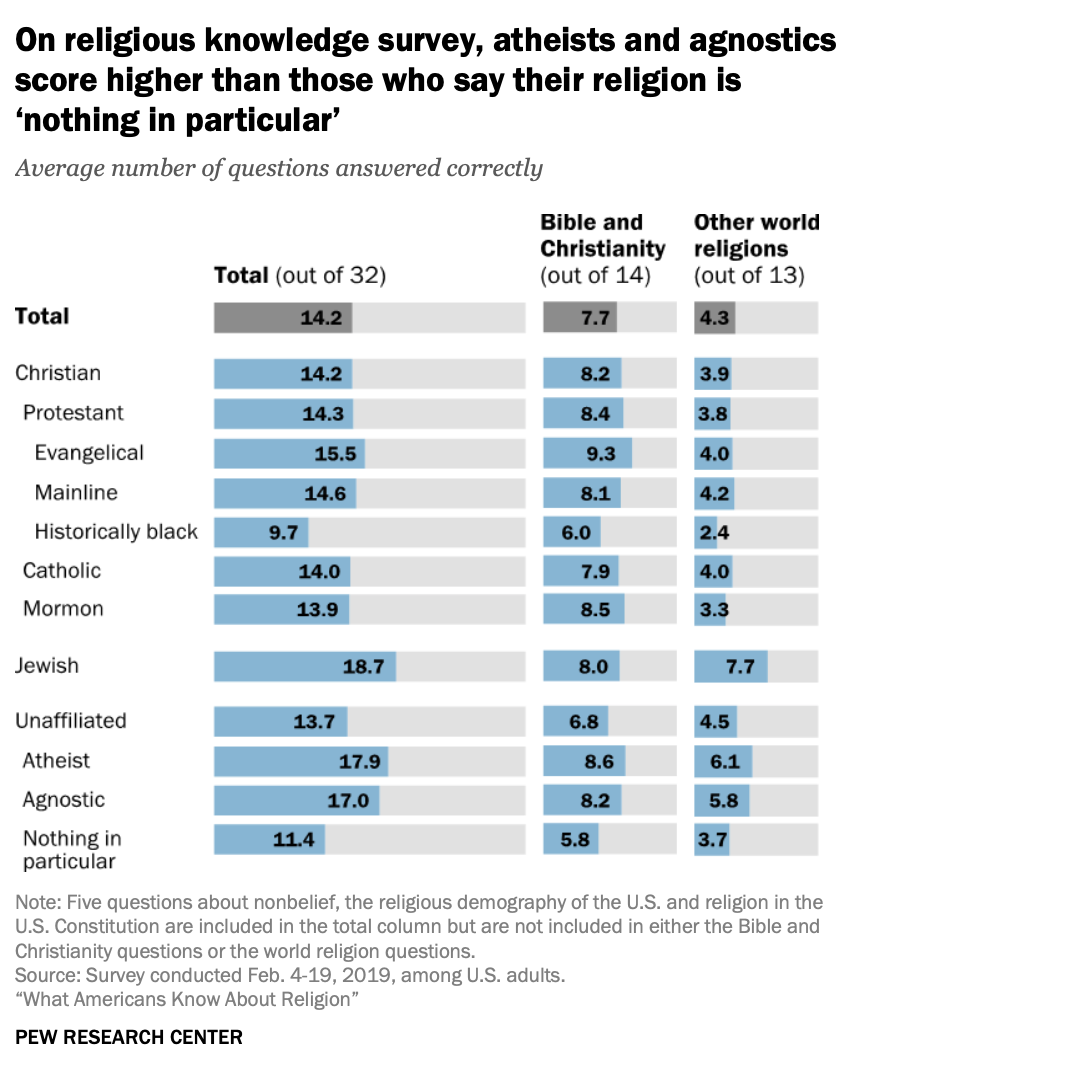
On page 1 of his introduction to his book Believe: Why Everyone Should Be Religious, Ross Douthat pretends that non-religious people are woefully ignorant about religion. The fact, however, is that on average, atheists know more about Christianity than Christians do, and much much more about religion in general than Christians do.
It’s Christians who are ignorant of religion, Ross Douthat, not atheists.
Transcript of the podcast episode:
Welcome to Not Everyone Believes, Ross Douthat.
This is a podcast that slowly, line by line, considers a book written by right wing Christian nationalist Ross Douthat, who is now a commentator on the MAGA 60 Minutes that was taken over by pro-Trump ideologues under Barry Weiss recently, and has become a Trump propaganda showpiece.
This is not a podcast of character assassination, though. We are examining Ross Douthat’s own words on their own merits.
His book, Believe: Why Everyone Should Be Religious, claims that to be religious is the rational thing to do, that you don't just have to take it on the authority of the preachers and priests, that it should be logically self evident for everybody to become religious, and believe, in things like gods.
In fact, the book ends up promoting Christianity in particular at the end. We'll get there, though, because right now we are not at the end of the book, we are just on page one, we have been through the acknowledgements. We've looked at the cover, the implicit argument in just the cover.
Now we are on page one of the book’s introduction. At this point, Ross Douthat is beginning to talk about why he's written this book, and he's trying to frame the mission of the book.
I want to pay attention to what he's writing about in just 2 or 3 paragraphs here on page one in the introduction because he's trying to describe who is not religious right now.
It's really interesting because he defines two groups. He does this in terms of the people who have written him letters when he was given the privileged position, in the media elite, having a position on the New York Times editorial board, in order to promote his conservative Christian views through that newspaper.
Douthat got letters in response to his editorial columns, and he says that there were two groups who were kind of objecting to his promotion of Christianity through the New York Times. I'm going to read some language to you straight from his book. He describes two groups.
“The 1st group predominated among my correspondents, lapsed Catholics, secular Jews, erstwhile Baptists, people with some sort of religious upbringing, who'd felt that they had given faith a chance and reasonably rejected it.”
So that's the 1st group: People who used to be religious, gave religion a chance and then left religion.
Now, notice here that he's only talking about Christians and Jews. Douthat only refers to Baptists, Catholic Jews. He's not talking about Buddhists. He not talking about Hindus, he's not talking about Muslims. That's pretty significant.
There's a kind of ideological narrowing in Ross Douthat’s ability to even think about religion here.
But let's go on to what he says about the second group.
“The 2nd group of people, over time, as church going in church membership declined in the United States, I noticed more members of the second group. Readers who seemed largely unfamiliar with basic tenets of Christianity, who had been raised with only a tenuous connection to institutional faith, whose knowledge of religion mostly came from history books and whatever they had picked up from friends and TV and social media.”
There's something that Ross Douthat is doing with this categorization that is rather dishonest. He's defining people who are not religious, as either 1) people who come from religion and therefore have knowledge of religion, or 2) people who maybe have never been religious, and they don't know about religion, and they're ignorant, of what religion really is. That's a very convenient kind of categorization for him to make, but it doesn't line up with the facts.
Let me tell you about what I'm talking about when I what I'm preferring to when I say facts.
I'm talking about a survey conducted in 2019 by the Pew Research Center.
What this survey did was take a look and see who knows about religion, who actually understands what religion is.
The Pew Research Center conducted a survey to see what people's religious literacy was, and the people that they surveyed included Christians, included Jewish people, and included people who are not religious.
And the people who are not religious were split into atheists, agnostics, and nothing in particular.
So, did Ross Douthat’s model hold up?
Was that described by this Pew Research Center?
Survey?
No, of course it didn't. It was not described by that survey.
Here's what actually was discovered in the survey.
In terms of religion as a general category, which includes, by the way, not just Christianity and Judaism.
There's actually other stuff going on out there, Ross Douthat.
Um, you know who knows the most about that?
It's Jews. Out of a potential score of 13 on what they called world religions, which is, you know, the realm of religion beyond Christianity, Jewish people got the highest rating.
You know who was next? Atheists.
Out of 13, Jewish people in the United States scored an average of 7.7 and atheists scored an average of 6.1.
You know what Christian scored? 3.9 out of 13. That’s amazing ignorance from American Christians about religion in general.
Okay?
Well, what about Christianity, though?
Because we know Ross Douthat, what he's trying to do is to promote Christianity, not religion in general. 1st he wants to get his readers to become generally religious, and then he wants to narrow them down to Christianity.
So who knows the most about the Bible and Christianity?
That's the category of a potential 14 points of this religious literacy survey, in 2019, the most recent survey from the Pew Research Center.
Well, Christians scored better about the Bible and Christianity than they did about other religions. They scored at 8.2 out of 14.
But you know something? Atheists scored even higher than that: An average of 8.6.
Atheists, people who are not religious, know more about Christianity than Christians do.
So, when we see Ross Douthat saying that, oh gosh, there are these 2 groups, people who used to be religious and therefore know about religion, and people who are not religious, who never have been religious, and gosh, they just don't know anything about it.
And they need help from someone like a New York Times columnist or a guy on a CBS news, right wing 60 Minutes show to educate them about religion, that's actually not reflective of reality.
People who are atheists, who don't belong to any religion, know more about Christianity and know more about religion in general than Christians do.
And why is that the case?
Well, this was a survey in the United States, and here in the United States, do you know what atheists have to put up with?
Day after day, month after month, year after year, they have to put up with Christians, who are trying to tell them what to do, who are forcing the education of everybody's children in Christian religion, forcing the pledge of allegiance. Every child in America to pledge to one nation under God. They’re forcing everyone to stop work, get out of school on Christian religious holidays, but not Jewish ones, not Muslim ones, not Hindu ones, not Buddhist ones. It's just the Christian holidays here.
In short, what I'm trying to say is that Christianity is pushy as hell in the United States. It shoves itself into everyone's life, whether they like it or not. So, when you're not religious, when you're an atheist and you have Christianity pushed at you, day after day after day, first of all, that's giving you a lot of information about Christianity, as it is.
I mean, Ross Douthat is kind of implying on this 1st page of his introduction that there's a real problem that it's getting difficult for children to find a way to learn about Christianity.
This is this whole narrative you hear in Christianity, that, gosh, it's, it's just, oh, all these people out there, they're unsaved because they've never heard the word of Jesus and the Bible and Christianity. I mean, that's kind of laughable because it's everywhere. Christianity is everywhere, being shoved at you all over the place. How could you not have heard it?
They want to believe that people don't follow Christianity because they haven't heard about it, or they don't know about it, or as Ross Douthat is saying, well, you just learned about it through social media.
Here's the other thing, is that when you're an atheist in the United States of America and you have Christians, not only personally, but using the U.S. Federal government to shove Christianity at you all the time, as we do now, I mean, you know, Pete Hegseth, in the United States military, has created a special authority to make sure to actually make sure that people in the army, U.S. Soldiers are “spiritually fit”, which means that they are good Christians. They're doing religious tests of soldiers in the military to make sure that they're Christian.
When you have this kind of stuff coming at you, When you have your public schools now teaching Christianity, and you're smart enough to know that something is being shoved at you in a way that is maybe not so honest and doesn't respect your individual freedom.
If you are an independent minded, rational person, you want to understand where that's coming from. You want to understand what you're being told and how that might be different from what's actually going on. If you look at a government that is increasingly fascist, pushing Christianity at you, and also at the same time sending soldiers in the name of Christianity out onto America's streets, sending masked government agents to grab people and put them into concentration camps, you want to learn about that religion because you see, it's not associated with freedom, it's associated with oppression.
So you want to learn about these things, when you have people telling you that you need to pray, you need to believe in Jesus, and they get on your case, and they don't leave you alone. They don't respect your independence and freedom. So, you want to learn about religion.
That's why atheists know more about Christianity, than Christians do. It's why they know more about religion in general than Christians do.
So if Ross Douthat really wants to take a look at where ignorance lies about Christianity and about religion, he should be targeting Christians, not atheists.
This is kind of dishonest what he's doing here in the introduction. Framing atheists as the people who don't know about religion.
Now, we're going to read through the rest of the introduction, but I think that's worth paying attention to, understanding that Ross Douthat is not acknowledging where the real ignorance lies in American society about Christianity.
We're not talking about a political agenda here. This survey was simply about basic facts, about the Bible and Christianity and other religions. Why is it that Christians know less than their non-religious neighbors?