Can Reason Ever Begin In Fear?
Welcome to Not Everyone Believes, Ross Douthat. This podcast is dedicated to a slow and careful examination of the argument that Ross Douthat makes in his book Believe: Why Everyone Should Be Religious.
The central conceit of Ross Douthat’s book is that religious belief is the natural end of reason. Douthat claims to prove that being religious is the only rational thing to do. That’s why he thinks not just some people, but everyone, should be religious.
We’re taking this book nice and slow, in order to give a detailed response to Ross Douthat’s line of thinking, rather than dismissing it with a quick and general judgment. In the first episode of this podcast, we considered the ideas presented on the cover, especially the extreme, absolutist demand that everybody be religious. Right away, Ross Douthat is making the most zealous case possible, one that does not allow for any exceptions, insisting on complete cultural conformity.
If Ross Douthat really thinks that everyone should be religious, that means he’d like to see a world in which not even one person is unreligious. He would like to eradicate the secular way of life completely. That’s not a moderate, reasonable position. It’s religious radicalism.
Now, in this second episode, we open the book and begin to peer inside, to see where Douthat chooses to begin his argument in favor of absolute, universal religious belief.
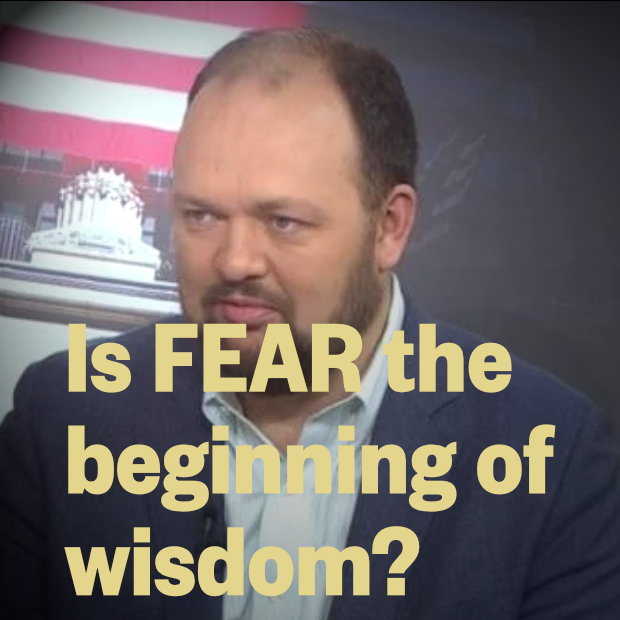
We don’t get any further than the acknowledgements before Ross Douthat undermines his own argument. Douthat begins with thanks to friends and colleagues, and that’s not controversial, but then ends his acknowledgement statement by acknowledges “God, of course: if the fear of the Lord is the beginning of wisdom, it’s also a good spirit in which to end one’s acknowledgements, especially for a book like this.”
Belief is a book in which Douthat claims to be making a reasoned argument in favor of religious belief as the only wise choice for absolutely every human being on planet Earth. But here, before even the main body of his book begins, Douthat is claiming that the opposite reverse is true.
Instead of beginning with an open mind, Ross Douthat is telling his readers that they should begin with their minds already closed, not only starting with religious belief in general, but with belief in the god of Christianity in particular. What’s more, Douthat proposes that his readers should begin with a very specific form of Christian belief, the faith that holds that the Christian god is an absolute ruler, the divine equivalent of a medieval warlord, who is so terrible that this god should be feared.
Is it wisdom to begin a project with a fearful mind? Fear is well known to restrict the scope and quality of our thinking. Fear is also a widely used tool of social control. Christian churches have long used the fear of invisible demons and harsh punishments after death to control the most personal aspects of congregants lives, even including the people they marry and how they have sex.
A sober mind is a more reliable source of wisdom than a frightened mind.
Fear is not a rational habit of mind. Fear is an emotion. There shouldn’t be shame in feeling fear. It’s something everybody feels, quite often. A reasoned perspective, however, does not begin with emotion. It’s impossible to filter out all the biases that are born out of our emotions, but with effort we can bring those biases under control. With rational exertion, we can even begin to question our biases.
Ross Douthat isn’t doing that with the “fear of the Lord” that he says he feels. He’s going beyond merely acknowledging that fear to celebrate it, and to praise its virtue as a baseline for everything else he writes in this book. That’s a surrender to irrationality.
As I read Ross Douthat preaching the wisdom of fear, I wonder what specific things he is afraid of so much that he would insist that everyone on Earth fall in line under the authority his invisible spirit Lord. Will Douthat identify the fears that motivated him to write this book in future chapters?
So far, this book takes a lot of things for granted. In the acknowledgements, we see that from the start, God is an “of course” for Ross Douthat, rather than just one proposition among many to consider. Douthat begins with the presumption that his fantastical beliefs are true, shutting off many lines of rational inquiry without even a cursory examination. A truly rational perspective doesn’t accept anything with the easy standard of “of course”. A rational thinker will carefully evaluate beliefs in detail, looking at all the premises that are used to support them, without taking anything for granted, especially when beliefs are themselves used to promote radical political agendas, as is the case with religious beliefs.
For Ross Douthat to abandon reasonable caution at the very beginning his book is suggestive of the level of thinking we’re likely to find further along, but it’s merely a suggestion at this point.
Not Everyone Believes, Ross Douthat, and that’s a fact, but we’ll take Ross Douthat’s book one page at a time.