Should You Believe Ross Douthat?
Lyrics to the podcast theme song:
Not everyone believes.
When people are free,
not everyone believes.
The religious elite says you should,
but not everyone believes, Ross Douthat.
What if you think, instead of believing?
What if you use your mind
instead of getting behind Ross Douthat?
Not everyone believes.
When people are free, not everyone believes, Ross Douthat.
Welcome to Not Everyone Believes, Ross Douthat.
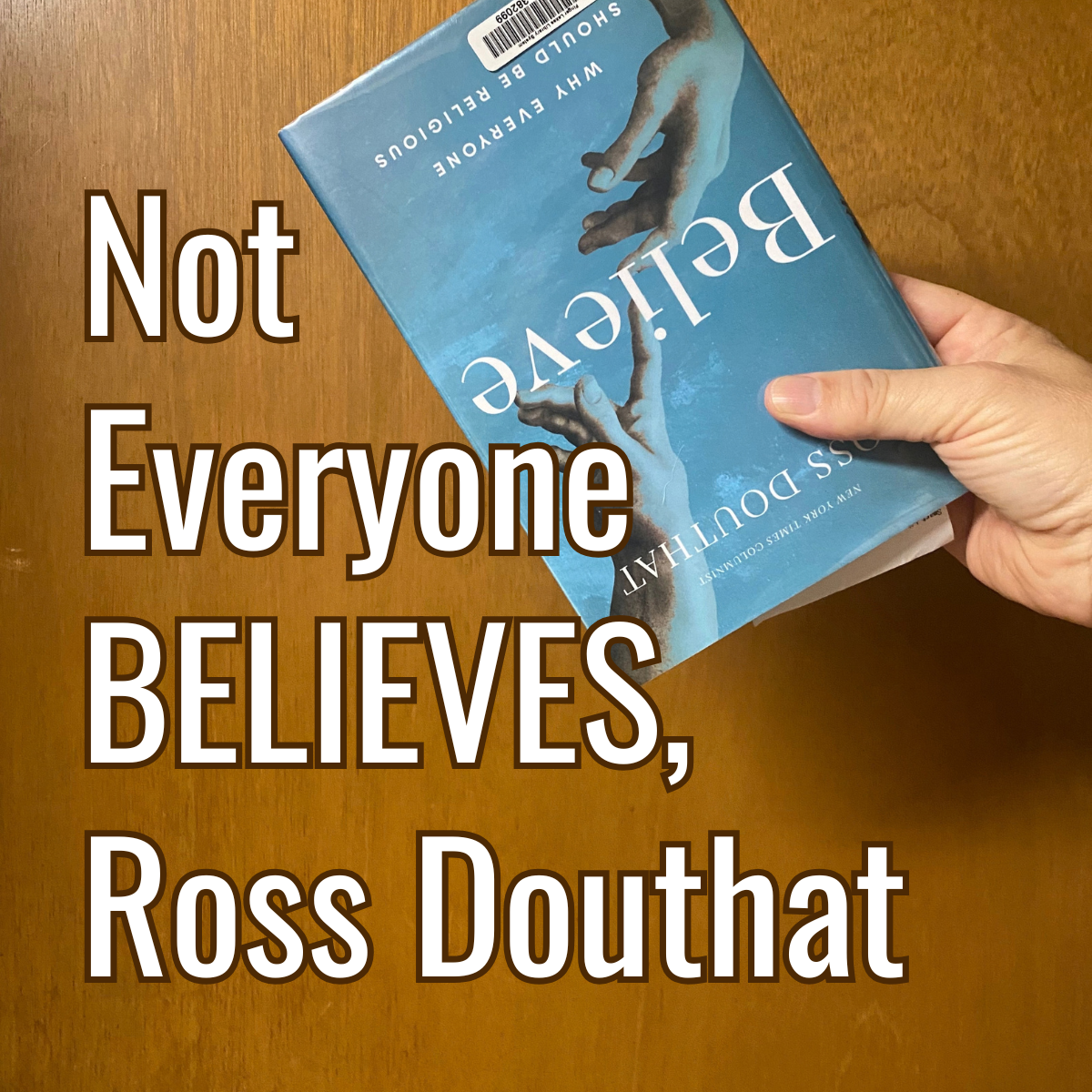
This is a very specific title for this podcast, and this is the very 1st episode, kind of a trailer, really to introduce you to what the idea of the podcast is. It's responding to a book published earlier this year by New York Times columnist, Ross Douthat, who also is a contributor to the new 60 Minutes… the 60 minutes that has been taken over by Donald Trump and Barry Weiss, Barry Weiss being a conservative ideologue, who has been brought into CBS in order to make Donald Trump happy.
I want to go through, in this podcast, episode by episode, all of the arguments that Ross Douthat makes in this book of his: Why everyone should be religious. That's its title… Believe: Why Everyone Should Be Religious by Ross Douthat.
In this 1st episode, I want to explain what makes this important. That importance is in what we just heard from the cover itself. It's what's at stake.
This is not a book that was written just out of idle intellectual kind of curiosity. No, it's got a very specific social program. It's got a purpose in our society in this time.
It was published in 2025, just about a year ago. Of course, this book did not appear out of nowhere. It was promoted vigorously by the New York Times and by conservative Christian nationalists. It's taking place in the context of Christian nationalism.
Ross Douthat is one of the top elites in the Christian nationalist elite in the United States of America today. Now he wants you to believe that he has some kind of opposite, outsider kind of status, that he's not an elite, that he's one of the downtrodden.
Actually, if we take a look at what's happening in the United States of America, right now, the entire federal government has been claimed in the name of right wing conservative Christian nationalism. On the 250th anniversary of this nation, that's what Donald Trump and a huge number of cabinet members from the government, some of the most powerful people, ever to exist in human civilization on this planet, have declared: They've said that the US federal government is now for Christianity.
In fact, they tell us, we're waging a war for Christianity. That's what Pete Hegseth says himself. This is a war against Iran, in the name of the Christian God.
It's in that context that we identify Ross Douthat is a Christian elitist. He is a member of a political and social and also an economic elite. He's quite well off. He's doing very well for himself. He's got connections among the rich and powerful, and he is publishing at the New York Times. Which is one of the most powerful publications ever to exist in the history of humanity.
Ross Douthat has been given a position there, on the New York Times opinion page, because of his conservative cultural position. It was a decision that the New York Times needed to have a representation of conservative Christianity in this time of Christian nationalism, that it would be unfair not to.
There has never been a decision by the New York Times editorial board that you need a liberal atheist to address the liberal atheist community in the United States of America. But conservative, right wing Christian nationalists get their own token member on this board. In this sense, you could say that Ross Douthat is a DEI hire, but for a kind of diversity, equity, and inclusion agenda that consistently favors people who already enjoy elite power.
Ross Douthat was brought in to the New York Times promote the idea that you must obey, you must believe.
The word “should” in the subtitle of this book, Why Everyone Should be Religious, is important.
So is the word “everyone”.
Think about the project of this book in those terms: Everyone should believe religion. These are words that are in the title of this book, and that's the essential argument of the book: Everyone should believe religion.
That's a pretty difficult argument to make, and Ross Douthat has set himself up for some deserved skepticism with that claim.
Ross Douthat is speaking on behalf of the interests of the rich and powerful Christian elite in the United States of America under Donald Trump. They put Donald Trump in power, and they also put Ross Douthat in power.
Ross Douthat is making an argument, not just that you should believe in religion in general, by the way. You'll see throughout the book that he's pretty clearly arguing for Christianity in particular, and for a Christianity that has the right to tell you what you should do.
That's why the book has the subtitle, Why Everyone Should Be Religious.
This is a religion that is monotheistic, that does not share power.
It's not a grassroots religion. It's not a religion of the people. It's not a religion of common sense. It's not a religion of reason and intellect and disagreement.
It's a religion in which powerful people take upon themselves the right to tell you what you should do, and in fact, to say that everyone should be doing the same thing, that everyone should believing, and be believing in the same way.
That's what has brought me to this book. I don't think that there has been enough consideration of the political agenda of this book and its placement and promotion by the most powerful media outlets of all time.
What I'll be doing in this podcast is to explore the thesis statement of this podcast: To say no, that actually not everyone believes, Ross Douthat.
Not everyone believes in this extremist, political, religious agenda that Ross Douthat is promoting, and continues to promote week after week on CBS 60 Minutes and in the pages of the New York Times.
This podcast is not arguing that there are not people who believe as Ross Douthat do, but rather that not everyone believes what he believes, and that to believe what he believes is not an obligation. It's not something that you must do, that you should do.
Obligation is a word that Ross Douthat likes to use an awful lot. He likes to tell people what they must do, and that they must follow the religious code that he believes in.
In response, this podcast is standing up instead for that old-fashioned American idea that we actually should have freedom of religion, that we should not have powerful people like Ross Douthat and Donald Trump telling us what religion we should have, what we should believe.
So this first episode. Of not everyone believes, Ross Douthat, has focused simply on what you could call the first page, the cover, the argument made by the title, the subtitle, and by the fact of this author's political and religious elitist connections.
Each episode is going to be detailed, considering the arguments and implicit arguments made in Ross Douthat's book. That means that it's going to be slow going for a while. This is not a podcast that is designed to give you quick and glib entertainment.
It's for people who want to actually think, instead of simply believing what they've been told to believe.
If you're interested in that, please tune back in. More to come soon, of…
Not Everyone Believes, Russ Douthat.