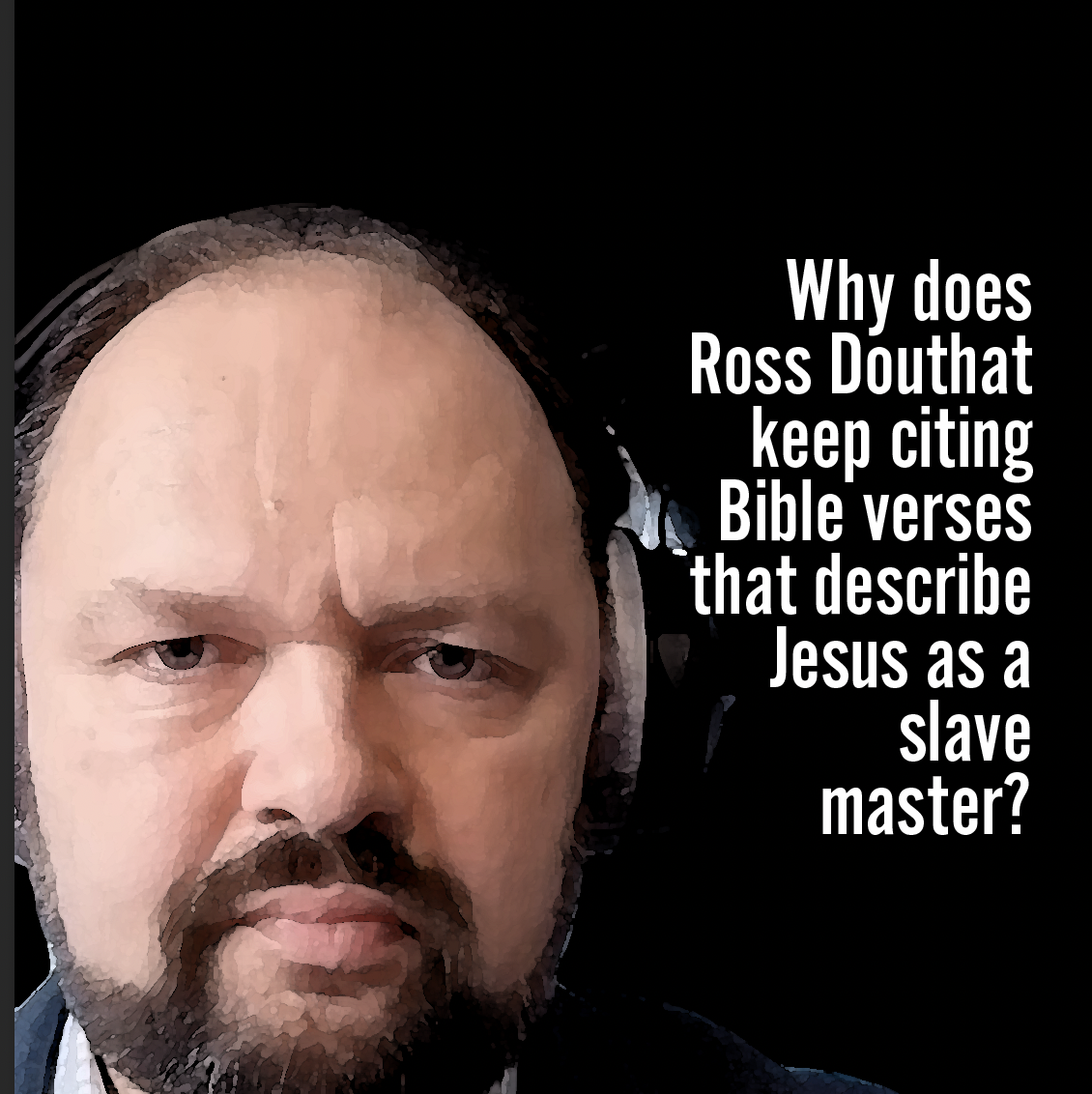
Not Everyone Believes, Ross Douthat
Is it curiosity for a slave to continue working on a plantation, for a master they have never seen, just on the off chance, that someday, that invisible, never seen master, actually show up? That is the argument that Ross Douthat closes his book with.
We are now on the bottom of page 205, in the top of, page 206 of Ross Douthat's book, Believe: Why Everyone Should Be Religious.
This is a book that argues that absolutely everyone on the planet should be religious, and not only that, in this last chapter, Ross Douthat is trying to make an argument of some kind for why you should be a Christian specifically, and a traditional Christian. Not one of these liberal Christians, but a conservative, right wing Christian like him.
To make this argument, Douthat cites a Bible verse that says, therefore, stay awake, for you do not know when the master of the house will come in the evening or at midnight, or when the rooster crows or in the morning, lest he come suddenly and find you asleep.
It's not for nothing that Ross Douthat is citing a Bible verse that describes the master of the house. Throughout these last pages, Douthat refers to Bible passages in which Jesus talks about himself as the master, and all of humanity being his slaves. Slaves, not servants.
In the last episode, I described these biblical as “servants” because that's the language that Christians often use to soften these Bible verses, to make them seem more palatable.
The Gospel in which this passage was written, in ancient Greek, uses the word doulou.
Doulou means slave.
The word doulou refers to a person who acts as servant, but does so while in servitude. They are owned. They are the property, the chattel of their master. So, Ross Douthat is arguing that we all have to be like slaves.
Jesus' own words were that we have to be like slaves, waiting for the master, our owner to return, and he's been gone for a long time.
But he could return, Christians are taught, at any time, and won't you be sorry, if he comes back, and he's angry with you because you've been living as if you are free? Jesus calls that kind of freedom evil.
That's right there in the Gospels. I encourage you to go look it up. I encourage you to actually study it and not just take it for granted what someone else tells you that it means, someone trying to reinterpret it as some kind of allegory, an allegory, a metaphor in which you are a slave. The claim that an invisible magical being that there is no evidence for is your master, is a rotten allegory, a rotten metaphor.
That invisible magical being, that God, that Jesus, that Messiah, that we never see, who never actually came back, when he said he'd be back soon, you know that's a proxy for human power, for the human power of the priests, of the churches, and of the politicians, who use those priests and those churches as political ammunition as a political machine to get their own power, as Donald Trump has done.
Going back a few lines, I want to read to you this final exploration of Ross Douthat's words in particular. This last paragraph on page 205, because this is the argument of why you should stay put as a slave on the plantation of Christianity.
“Life is short, and death is certain, and what account will you give of yourself if the believers turn out to have been right all along? That you took pointlessness, for granted in a world shot through with signs of meaning and design? That you defaulted to unbelief because that seemed like the price of being intellectually serious or culturally respectable? That you were too busy to be curious, to consumed with things you knew to be passing, to cast a prayer up to whatever eternity awaits?”
You know, it strikes me that even at the end, Ross Douthat can't even fully commit to the particular eternity that he believes we all should believe in. Of course, it's too specific and too implausible to earn our belief.
Here's the promise: If Jesus is the master, and we are the slaves, and we're supposed to believe after an entire lifetime that we've lived, and thousands of years for everybody else, in this failed promise to return, to come back from the dead, and return and be the master of all of us as slaves once again.
That's where the New Testament ends up in the Book of Revelation too. It not just in the Gospels.
This is the message of the New Testament: You're a slave, you should obey. Jesus is your master.
Ross Douthat can't even say that actually this is what the eternity is, is for you to be a slave forever and ever to the awesome master that is Jesus, and trust us, he's awesome, even though you've never met him in person, there's this book, this ancient book that says he's going to be a great, great master, and if he doesn't come back, boy, you'll be sorry, you will live forever, you won't ever die, but anyone who questions this.
Anyone who questions this will be tortured, and will be killed, and then after death, they're going to be tortured again. So boy, you better believe. That is the language of a slave master, isn't it?
Ross Douthat can't bring himself to describe that. He just refers to it as “whatever eternity awaits”. It's an eternity of suffering for most of the people who live on Earth. Eternal suffering. Do You want to cast a prayer up to that invisible slave master who wants to torture most people forever?
Let's look at this: “What account will you give of yourself if the believers turn out to have been right all along?” This is the language of one slave saying to another slave.
I don't think this master exists. Why don't we leave this plantation of Christianity?
The master, the guy who says that he owns us, I don't think he actually exists. Have you noticed that he never shows up here? We could just walk off this plantation and we could live in freedom.
The other slave, who is Ross Douthat, says if you're going to just leave this plantation of Christianity, well, what if you're wrong? How are you going to account for yourself then?
Ross Douthat the slave, says to the other slave, that life out there, away from the plantation of Christianity, if you walk out there, do you know what there is waiting for you? That whole world is just pointless. You living in freedom in that world is pointless. How could you live without a master telling you what to do all the time? How could you live without those rules? How could you be free?
Freedom is pointless. This is what Ross Douthat is arguing here.
Then, this slave Ross Douthat says to the other slaves who are tempted to escape to live in freedom: You are defaulting to unbelief, not believing that this invisible slave master is real. I guess you just think that you're smarter than the rest of us, don't you? Do you think like you're going to be culturally respectable by being free by following your own path in the one life that you've got? I guess you just think that you're better than the rest of us. That's the insulting, snide, emotionally manipulative argument Ross Douthat is making in this passage.
Then Ross Douthat says: Aren't you curious? Do you lack curiosity so much that you don't want to stay on this plantation and continue to be a slave, and give your life over to this invisible non-present master, just to see what happens? Aren't you just so curious that you want to stay on the plantation and not follow your own path in life?
No, Ross Douthat. I'm not curious in that sense. Not everyone believes, Ross Douthat.
That's because we are curious about the larger world that exists beyond the slave plantation of Christianity. I know it may seem offensive to Christians that I keep on referring to the slave plantation of Christianity, but that is the very language, the very metaphor that Ross Douthat keeps citing. That model of Christianity as slavery was first spoken by Jesus in the Gospels.
Everyone wants to tell you that Jesus was a really nice guy, but Jesus, I have to say, a nice guy does not psychologically manipulate people to worship him, to give up their own freedom for the sake of his prestige, psychologically manipulating them into giving up their own freedom, their own curiosity, their own intellectual seriousness.
Ross Douthat mocks intellectual seriousness here at the end of his book. That's not being a nice guy. That is the religion of a narcissist. It's telling that at the very end of his book, Ross Douthat is mocking intellectual seriousness. He's been doing this in a book that began with the premise that he was going to make rational arguments.
Next week, there will be the final episode of this podcast, Not Everyone Believes Ross Douthat, because this is a limited book we’re exploring. It's a relatively short book that was written by Ross Douthat, which we’ve gone through chapter by chapter, page by page, line by line.
Next week's episode will provide a summary of what this book is arguing, looking at the full scope. It will consider, given everything that Ross Douthat says, does it make any sense at all to believe, to be religious?