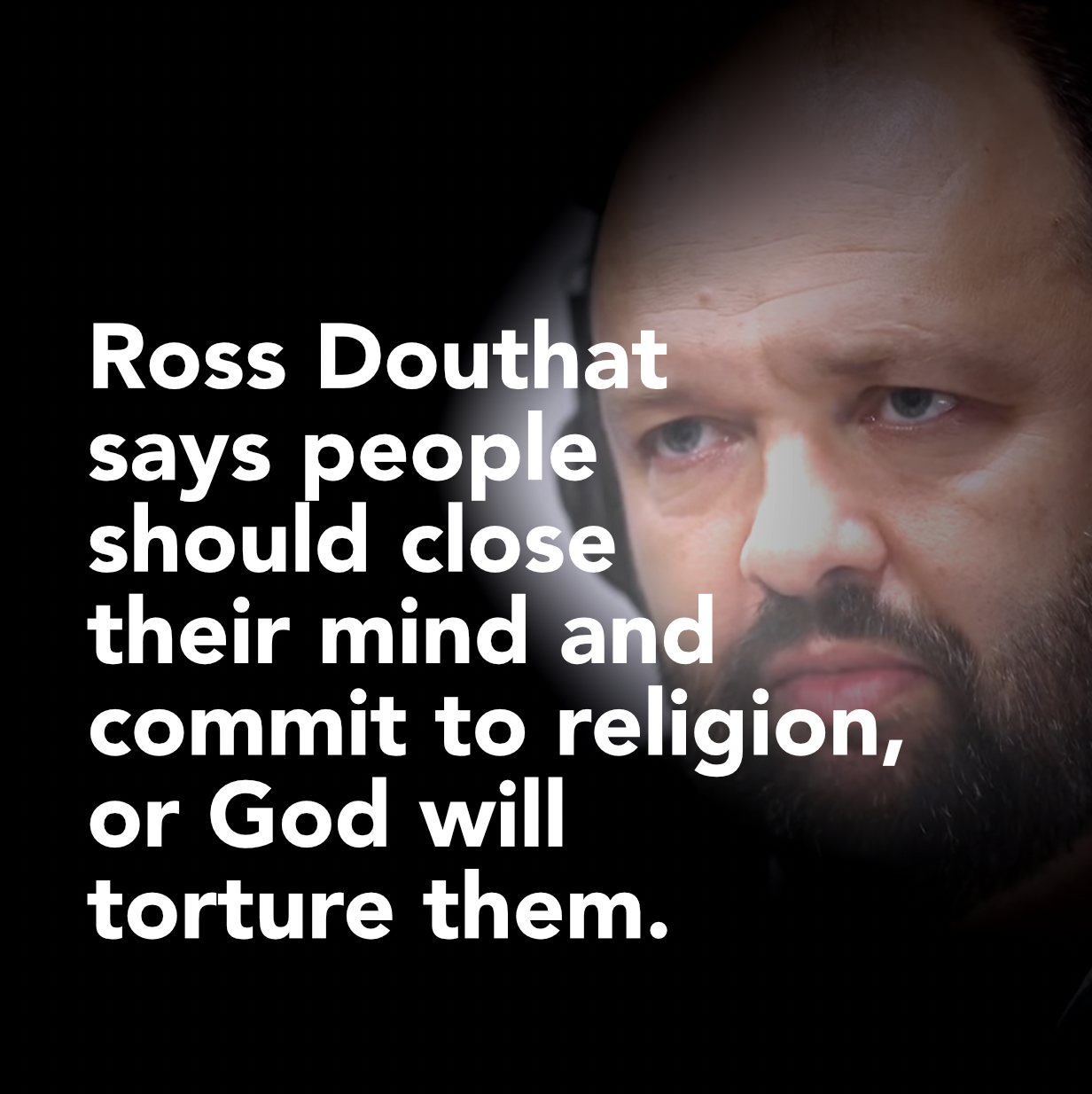
The further you read in Ross Douthat’s book Believe, the worse it gets. In chapter 4, Douthat is now making unsubstantiated claims that people should be tortured if they don’t close their minds and fully commit to believing the right religion. Douthat also cites a chapter in the violent Book of Revelation that was used by Nazis to justify the genocide against Jews under the Third Reich.
Do you still think Ross Douthat is a reasonable moderate?
Podcast Transcript
Thank you for coming back to listen to another episode of Not Everyone Believes, Ross Douthat. This is a podcast that is examining one book. That book has the title, Believe, Why Everyone Should Be Religious.
Everyone should be the same? That’s quite a claim.
So far, the author of this book, Ross Douthat, does a terrible job at his attempt at rational justification for religious belief. At every turn, Ross Douthat is engaging in sloppy thinking, engaging with only the facts that suit the argument that he's trying to make. He makes assertions without backing them up. He profoundly misunderstands science and misrepresents it over and over again.
We are now past Ross Douthat's attempt at providing a rational basis for belief in religion. He has completely failed to do that.
What Ross Douthat is doing at this part of the book, we are on page 112… If you happen to have a copy that you got out from the library. I do not encourage you to buy this book. Get one from your public library. It's really not worth the money to buy a copy yourself. Anyway, the point is that it's at this part of the book that Ross Douthat he thinks that he's convinced people to become religious in general. So now, he's starting to tell the reader what kind of religion they should engage in, what they should believe in as a religious believer.
Guess what? The religion Ross Douthat is going to tell readers they should choose will be Ross Douthat's own conservative Catholicism. His right wing Christian nationalism. It's not much of a surprise, is it?
On page 112 of his book, Ross Douthat is beginning with what seems to him to just be a natural argument, but to any reader who is paying attention to what has been said, it comes out of left field. Ross Douthat started this book with the promise that he was going to be rational about this, but here in chapter 4, Ross Douthat is beginning to tell readers what kind of religion they should belong to. What he's saying is that you shouldn't be open-minded about it.
Ross Douthat is saying that you shouldn't be open-minded. He writes: “Permanent open-mindedness is not necessarily a virtue. In the end, the meaningful life is usually the committed life. The dilettante's posture must yield at some point to the active choice. Better to face the consequences of even a mistaken commitment or decision than to hear, at the last, the fateful judgment, ‘because you are lukewarm and neither hot nor cold, I will spit you out of my mouth.’”
That last bit of what Ross Douthat wrote is a quote from the Book of Revelation, chapter 3. The Book of Revelation is the last chapter of the New Testament of the Christian Bible.
Why is Ross Douthat quoting the Christian Bible as evidence that you should believe in the Christian Bible? That's not rational. That's not logical. That's circular.
This is where we see how far Ross Douthat has gone off the rails.
The idea is that you should definitely commit to an idea, and that when you do, you should go all the way in. You shouldn't keep an open mind and continue to think about things and evaluate your life as it comes up in the moment. No, what you need is an ideology that you are committed to, and you can't be halfway about it. You can't just be lukewarm about that ideology. You have to be all the way in.
Why?
According to Ross Douthat it’s self-evident, because when you die, you're going to be judged, and you will be punished, if you don't belong to the right ideology.
Whoah. Wait a minute. Where did Ross get that idea from?
You know the answer. This idea of judgment and punishment after death comes from the ideology that he's already committed to. So, the ideology that he's committed to has told him, in the Book of Revelation chapter 3, that he must be absolutely committed to an ideology and close his mind to all other possibilities. His ideology says he'll be punished if he doesn't do that.
Therefore, it must be true. I mean, Ross Douthat is saying it must be true because his ideology says it's true.
What evidence is there, though, that when you die, you're going to be judged at all by anybody or anything? We have no evidence of that. Ross Douthat has not taken any effort really to prove that point.
He says a little bit in the previous chapter about how sometimes, among the very small minority of people who, when they get very sick, have dreams that they categorize as near death experiences, and within that very small minority, the even smaller minority that has religious tones to the dreams that they have when they're very sick, within that very small minority of a very small minority, there are sometimes religious dreams that people have when they're very sick, close to death, and sometimes some of those tiny number of religious dreams contain a suggestion that people might be judged.
So essentially, the closest Ross Douthat has come to a rational argument in favor of divine punishment after death is that in a very very small number of cases, people who are sick have reported having dreams in which characters say that there's going to be a judgment when we die.
That's his evidence that we all need to live in fear that we're going to be judged by the Christian god if we don't believe with complete commitment. That’s all the evidence he has that when we die, we're going to be judged by a magical spirit who likes to punish people.
That's a terrible standard of proof. That's not evidence. People have dreams of all kinds of things, after all. What’s more, a lot of Americans have been raised with the belief, and have been indoctrinated by adults when they were children to believe that death equals judgment, so you'd better obey. You'd better obey your parents, but even more importantly, you'd better obey the church. You'd better do exactly what the church says, and you'd better live your life according to the rules that the church puts down on you because if you don't, you'll be punished after you die.
Ross Douthat was raised within that religion from his birth. The minute he could begin to understand language, his parents started to indoctrinate him in this ideology, taking him to church over and over again. It wasn’t a rational choice for him, to be indoctrinated in this ideology.
In this book, Ross Douthat has not done a single thing to bring any non-believers along in any reasonable way to share his belief that something mystical happens after death. First of all, Ross Douthat fails to provide reason to believe that there is a soul at all. I haven't ever seen a soul.
Secondly, Ross Douthat fails to show that any soul, if it does exist, will survive after death. Why should I believe that? I've never seen a soul that has come back after death to float around in my garage, maybe, and say, “Boo! Do you have any potato chips? Boo!” Nothing like that has ever happened.
Then I'm supposed to believe, without any evidence, that I'm going to be punished if I don't agree with Ross Douthat? I'm going to be punished after death because I don't agree with Ross Douthat, and furthermore, that I if don't absolutely commit, that's a sin, a sin to to not go all in on an ideology and to close your mind?
I mean, that's what Ross Douthat is saying. This is not rational.
If you want to say that you are going to make a rational argument, and then in the middle of the rational argument, you'd start telling people that they have to stop thinking, I don't think you have any credibility.
Ross Douthat is also arguing that to have open-mindedness is to be a “dilettante”. To that, I say, leave your French-derived fancy terms out of this.
What are you actually trying to say, Ross Douthat, that there's some kind of decadence in keeping an open mind, that if you're so open that you refuse to commit with a fervent mind?
Are you saying I should commit like MAGA voters have committed? Are you saying that if we're not like MAGA voters, supporting the fascism of Donald Trump absolutely, without thinking about it, closing our minds to any other possibility, were dilettantes?
That's what Ross Douthat seems to be saying. It’s nuts. Ross Douthat claims to be a moderate, but then he accuses people of being dilettantes for keeping an open mind. I just don't get how people think that Ross Douthat can be considered to be a political moderate. Ross Douthat is encouraging the closure of minds.
You know who keeps an open mind, lifelong, professionally? It's scientists.
I don't mean to say that if you are not religious, you have to professionally become a scientist. I do think that there's more to the perspective of science than just becoming a chemist, a biologist, an astrophysicist, or something like that. There's more to science than that.
Science is an attitude. It has at its foundation, an attitude of being willing to admit that you are wrong, being willing to consider new facts when new facts are discovered.
When Ross Douthat says that you can't keep an open mind, that keeping an open mind is some kind of decadent indulgence, and it's impermissibly liberal, that’s the kind of implication of his use of the word “dilettante” there. He's saying that we should not have a society that's based on science, on facts, that we as a society should close our minds to new ideas and new information, because if we keep our minds open, we will stray off of the true path.
Ross Douthat actually says that he's going for capital T truth here, in terms of which religion you have to belong to.
I want you to think about what life would be like if we did not have science. We would have the kind of world that Robert F. Kennedy seems to be leading us back into, one where infectious diseases run rampant, one where we don't have antibiotics. Think about what that world would be like.
We also would have a world that was run by churches, in which, if you dare to express an idea that does not go along with what the church teaches, you can be burned at the stake. That's the world that we had before the Enlightenment.
That's what the North American European colonies were like before Enlightenment thinkers came together and sparked the revolution of 1776.
Of course the revolution of 1776 was about other things as well, but the founding of the United States of America was in alignment with Enlightenment and science.
People like Benjamin Franklin were part of it. They were not perfect. I'm not meaning to say they were perfect. That's a religious perspective to think that if somebody had a good idea, they should have been good in all aspects of their life, that they have to be a prophet like Jesus and be perfect. I'm not making that argument.
What I'm saying is that before we had the overthrow of the British colonial governments in North America, we had people being tortured because of their religious beliefs. We had people being exiled from certain colonies because they didn't go along with the government's version of what it meant to be religious. We had witch hunts. We had all kinds of crazy stuff.
That religious insanity is what we go back to if we go back to Ross Douthat's attitude, which is that you have to commit, and you have to stop keeping an open mind about these things, that you have to obey, or you're going to be punished.
That's why I want to get back to the Book of Revelation. The Book of Revelation that Ross Douthat cites is an extremist piece of religious propaganda, that at its core has the idea that obedience to absolute authority in a hierarchy that is chosen by God is the best form of government.
The Book of Revelation is a threatening piece of propaganda that says that anyone who refuses to obey the religious leadership of the Christian church and its God and its kings will not only be killed, but will be tortured without mercy at length, simply because they don't believe the right thing.
It is not an accident that Ross Douthat is choosing that part of the Bible to cite as a foundation for belief. It is a very Christian idea, that model of torture and mass murder and religious warfare. The idea that that punishment will continue in the afterlife, that the Christian god is a god of torture and vengeance and sadism, and absolute monotheism on a cosmic level, that's what monotheism is. It’s tyranny at a universal level in which your job is to submit absolutely to that religion and to its human representatives, the priests and the kings that they appoint to earthly power.
It's also telling that the chapter of the Book of Revelation that Ross Douthat chose is one that contains a reference that has been used by the Nazis to justify their extreme violence.
Yes, the Nazis were a Christian movement. No, Adolf Hitler was not an atheist. He publicly stated he wasn't an atheist, repeatedly. The Nazis, you know, they had the motto “God With Us” on their belt buckles. God mit uns.
They cited the same book, The same chapter of the Book of Revelation, that Ross Douthat cites. They did that because it contains a reference, which is supposed to be straight out of the mouth of Jesus. All of this torture and violence and threats, an absolute unforgiving tyranny comes, the Bible says, as the testimony of Jesus, the words of Jesus. It's right there in the 1st lines of the Book of Revelation, the last book of the Christian New Testament.
Well in this chapter, the 3rd chapter of the Book of Revelation, it talks about Jews who refuse to follow Jesus. It accuses them of being the “Synagogue of Satan.” So it's all right, according to the Book of Revelation for you to be genetically, hereditarily, ancestrally Jewish, but it's not all right for you to continue to practice Judaism. You have to practice Christianity, if you don't practice Christianity, you aren't a follower of God, you're part of the synagogue of Satan.
That phrase from the Book of Revelation, from the chapter that Ross Douthat cites was used to justify genocide against the Jews way before the Third Reich, the Nazis, Adolf Hitler.
There were pogroms, for example, during Christian Crusades. You know what they used to do? The Catholic popes would say it's time for a crusade, and they would form a Christian army, that Christian army would go off toward the east, but they wouldn't just attack Muslims in that religious war. They would also, along the way, find Jews, and they would bring them out on the streets and slaughter them and torture them. They would do it in the name of Jesus.
The Book of Revelation is like that. The Book of Revelation is full of armies that are going to kill everyone who refuses to follow Jesus and torture them for months on end before the Christians allow their victims to die. Then Jesus comes, and Jesus does even more torture.
Torture and killing and cruelty is at the end, the final scene of Christianity. Torture is the ultimate message of Christianity triumphant, with the King of Kings and the Lord of Lords, violent retribution to establish absolute social control with everyone who survives, left on Earth, bowing and bending their knees in total obedience to the divine authoritarian power.
What Christianity wants to establish is an evil empire that nobody has the power to resist. That's the same kind of attitude that drove the Nazis that drove the crusades. Now Ross Douthat is citing that same chapter, with the “Synagogue of Satan”, to accompany his demand of a closure of your mind.
I want you to listen to just what he's talking about just on this one page, this attitude of supporting absolute power and the closure of human minds. Then we can go over to the next page, where he asks rhetorically, what if you want to be an individual? What if you want to be an individual who is following your own religious quest? What if you could keep your own mind open enough to discover new things and maybe believe in the supernatural if you want to? What if there are angels, and maybe you could go talk to them or you could pray and you could learn from your prayers?
Boy, you could be an independent religious individual. Isn't that okay? Ross Douthat asks this as a rhetorical question, because no, Ross Douthat says, no, that's not okay.
His reason to say this is that, “You are probably not a religious genius.”
What Ross Douthat is arguing here is that the chances are that you're not very smart. You don't really know.
What Ross Douthat is arguing and continues in the next few paragraphs to argue, is that there have been very smart people who have set up Christianity. Do you think you're as smart as them? No, Ross Douthat says. You're almost certainly not as smart as them.
So what you should do, recognizing that you're stupid, that you're not a genius? You're not smart enough to figure out things on your own. You should just believe what you're told, because after all, smarter people than you have figured it out.
This is coming from the author who told us that he was going to give us a rational argument. Ross Douthat said he was going to provide a thinking person's justification for Christianity, but now he's telling the reader you're not that smart. Other people are smarter than you, so you know what you should do? You should just believe what other people tell you and not keep an open mind and just go along with it because they're probably right.
The people who are in religious power are probably smarter than you. So just don't think too hard about it. Just commit. Just go along.
Just go along, says the man who cites a Bible passage that has been used to justify the Nazi Holocaust.
That is a pretty big reason that not everyone believes, Ross Douthat.