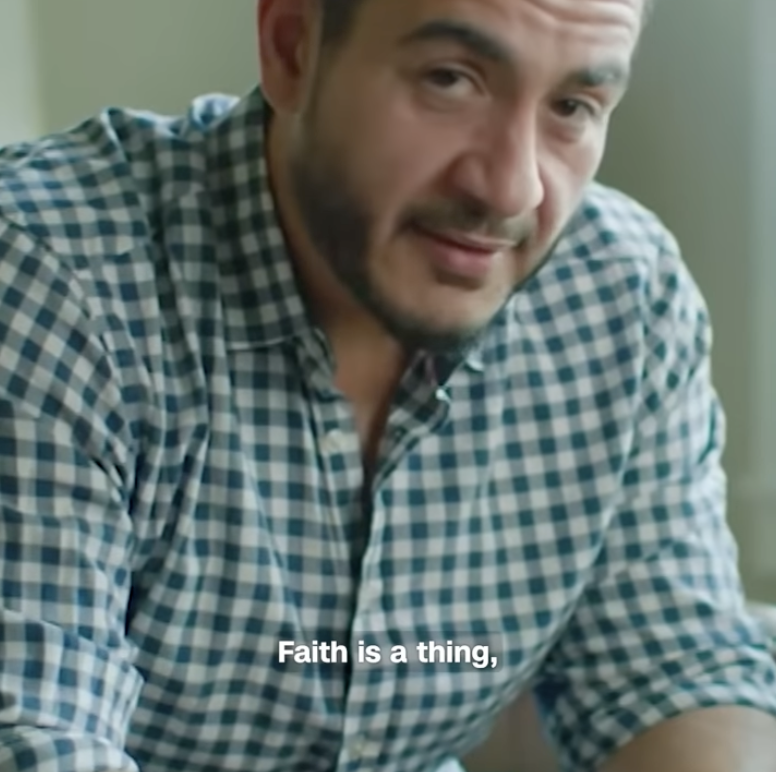
Politics in Washington DC is thoroughly dominated by faith, by religion, so when Abdul El-Sayed says that there isn't enough faith in Washington, that concerns me.
Will he, and the other Democrats in DC, do anything to restore separation of church and state?
I want to make something really clear before I share my main message today.
I don't think that there should be anything about a political candidate's individual position on religion, membership in religion, beliefs about it. I don't think that that should impact their eligibility for public office. I don't think that people should be rejected for their individual ideas about religion or their religious identity.
So, I think it would be wrong to discriminate against somebody who's Jewish or Christian or Muslim or Buddhist or Hindu, as much as I think it would be wrong to discriminate against somebody who is atheist, somebody who is a humanist, somebody who is an agnostic, a skeptic, or in any other way godless.
That said, I'm really concerned about what a particular political candidate had to say in this recording.
“Faith is a thing there's just too little of in Washington.”
The person who said that statement was not a Christian nationalist wasn't a Republican in any way, the person who made that statement was a Democrat, who's going to be joining the U.S. Senate, Abdul el-Sayed.
Abdul el-Sayed has a lot of great policies, but I have to differ on this one. The idea that one of the problems America is facing is that there is not enough faith in Washington, DC. Is ridiculous.
There is not a single non-religious member of the U.S. Supreme Court. There never has been an atheist, never been anything other than a Christian or a Jew on the United States Supreme Court. There has never been a non-religious president of the United States, never a non-Christian.
In the U.S. Congress, we have an overrepresentation of religious Americans over non-religious Americans. There is an overrepresentation of Christians, to be sure, but also of religion in general.
The non-religious population of the United States of America is between, 20% and 30% depending on how you count it, maybe as high as 35%, depending on how you count it. Atheists are at about 20%, being people who do not have any belief in any gods. Yet, we do not have 20% of the members of Congress being atheist.
There are just a small, small, tiny number, less than a handful of members of Congress in the U.S. House of Representatives who acknowledge that they are not religious and they don't believe in any gods.
So actually, you know, if you care about diversity and representation, we have way too much faith in the United States of America. If you take a look at policy, what's happened over the last couple of years, is that the United States of America has been made into a Christian nation, a religious nation, an officially religious nation, so that people of faith have their own office in the White House, they have their own officers representing them in both houses of the U.S. Congress.
We have people in the US military who are hired to proselytize soldiers, to support their religious identities, but now the atheist identity has been wiped out as an option for soldiers. Soldiers are no longer allowed to say that they are atheists in the U.S. Military.
So, I wonder what Abdul el-Sayed means when he says that we don't have enough faith in Washington, DC. It seems that we have an awful lot of people of faith in Washington, DC. Honestly, it seems to me that the people of faith are, on the whole, those people who have been supporting fascism. Not all people of faith do, not all religious people do, but on the whole, yeah. Religious Americans have been supporting Christian Nationalism, been supporting Christian Nationalism.
It's been the atheists who have been the number one demographic opposing that, opposing not just discrimination against atheists on the basis of religion, but discrimination on the basis of gender identity and nationality and all kinds of things.
Supporting access to science, supporting access to You know, food for the hungry in medicine, for the sick, homes for those people who don't have any. The people who have been most strongly, consistently supporting compassion in the United States have been atheists.
We don't have an atheist office in the White House. We don't have an atheist chaplain in Congress. We've never seen an atheist in the Supreme Court or in the White House as President or even Vice President of the United States of America.
We've had problems, even as we've had an overrepresentation of faith, of religion in Washington, DC. Then there is the point about what faith actually is. Faith is belief in something even when you don't have evidence for it.
I think that really represents what Robert Kennedy Jr. is up to as he's campaigning against scientifically valid medicine. In the wake of that, we have the spread of infectious diseases that are completely preventable, killing people now across the United States. The United States is about to be decertified as a country that got rid of measles. We got rid of it in the year 2000, and now thanks to faith, it’s back.
It's roaring back, and you can't blame the atheists for that. That's because of faith.
That's because we have, instead of actual science, we have ideas that people believe in because it seems right, and because they have faith, they don't need evidence.
That's faith for you. That's what faith is, and I don't think that that's really an appropriate value to bring to the U.S. Government.
I support the right of Muslims and Hindus and Bahai and Sikhs and all kinds of people, of all religions, even, you know, even evangelicals. I support their right to serve as members of Congress or the president to be on the Supreme Court, but what I would like to see is that they bracket their faith when they do that, that duty. When they're in government, they're supposed to be there for all the people, not just people of faith.
When I hear Abdul El-Sayed say that the problem we've got is that we don't have enough faith in Washington, DC., it kind of feels like he's blaming non-religious people saying non-religious people are to blame for what's going on in Washington, DC.
Maybe that's not what he meant. Maybe he just meant that the people in Washington, DC, they say they're religious, but they're not really, or maybe they're religious, but they need to practice their faith more or whatever. The thing is, we all know what that kind of language has been used to perpetrate in the past. It's been used as a slur against atheists. It's been used as a way to say that the problem is godlessness, and we need more church, and we need more religion in government.
I don't think it's the business of any member of the U.S. Senate, the House of Representatives, Supreme Court, the presidency, to say that we need more faith. It's not supposed to be the role of government to establish religion or to promote religion. There's not supposed to be a test of religious identity in order to get into public office,
Nonetheless, in the 2026 election, that's the game that the Democratic Party played. They chose conspicuously religious people to run for Congress. They did that even though the most reliable voting bloc that the Democratic Party has got has been non-religious Americans.
Year after year, we show up for the Democratic Party. Year after year, the Democratic Party fails to show up for us.
I looked at the website for the Democratic Party, their press releases. There wasn't a single statement made about the danger of Christian nationalism by the Democratic Party in 2026 or in 2025. Not a single statement released. The last time they did that was a couple of years ago.
The Democratic Party seems to have made the calculation that talking about the attacks on the freedoms of non-religious Americans or non-Christians who are of other religions just isn't good politics
So, Abdul El Sayed seems to have been reaching out across the aisle, so to speak, of the mosque of the church, to Christians, in Michigan, to voters there saying, hey, I'm not a Christian, but it's okay. I'm all right. I one of you. I'm religious, and we need more faith in Washington, DC.
I don't think that Abdul El Syed will do anything to introduce new laws to discriminate against non-religious Americans. But the question is whether he's going to do anything to take back what's happened, to fight against Christian nationalism, to fight against the infiltration of religious power into government.
Is he going to do anything, for example, to reestablish the rule that the IRS used to enforce that churches could not engage in partisan political campaigning and have tax exempt status at the same time? Of course, it's too early to say what newly elected Democrats will do in 2027. We have to wait until they get into office. So, I can't judge Abdul El Sayed in terms of what he has done and or what he has not done yet.
We can look at the current U.S. Congress. We can look at the Congressional Record so far that's available since the election. There hasn't been a single mention from a Democrat or a Republican on separation of church and state. There has been no speech talking about that needing to be restored.
There is a mention of a new co-sponsor of a Senate bill that would make it illegal for anyone to protest near a church, to actually create a special protection for religious organizations that doesn't exist for non-religious organizations, that those religious organizations should be protected from protests against their policies that nobody else gets protection from. So, we see Congress working to create another special privilege, another special privilege for the elitism of religion.
I don't hear any politicians talking about separation of church and state. Instead, what we have is in Alabama, there's been a voter resolution that puts school prayer in the state Constitution.
At the U.S. Supreme Court, the Christian Nationalist dominated Supreme Court is now hearing arguments for a case in which Christian nationalists are demanding the right to get government funding for religious schools that then will have the right under freedom of religion, to exclude the children of same-sex couples, under the idea that religious people have freedom of religion and therefore have the right to discriminate against everybody, that they have the right to government money in order to engage in that religious ritual of discrimination, that Christian ritual of scapegoating, vulnerable people. That's now being considered by the U.S. Supreme Court, as an example of freedom of religion, the right to have government funded religious bigotry.
So, when I see that, Abdul el-Sayed, frankly, I think we've got too much faith in Washington, DC. You have your right to individual religion, but were you sent to Washington, DC, to be a religious person, or were you sent to be a United States senator?